
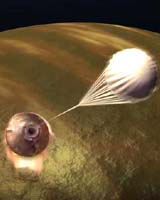
The Mars Express spacecraft, carrying the Beagle 2 lander, was launched on 2 June last year, arriving in the vicinity of Mars in December. The separation of Beagle 2 from Mars Express occurred on 19 December. The satellite continued its mission with its successful insertion into a Mars orbit on 25 December, the day on which Beagle 2 was due to land.
The public may never be told why Britain's first Martian probe – Beagle 2 – disappeared last Christmas as it was about to land on Mars.
Investigators have not been able to pinpoint a single failure or shortcoming of the $90 million probe, reporters were told at a London news conference Monday.
However, the British government and the European Space Agency have refused to reveal the detailed findings of an inquiry into the loss of the unmanned spacecraft, the Daily Telegraph reported.
The report has been kept confidential to protect commercial interests and ensure no one was afraid to come forward with evidence, according to the agency.
Professor Colin Pillinger, Britain's chief scientist for the mission, said only four copies of the report had been made and he had not seen any.
Pillinger has said he believed a Martian heat wave and! accompan ying dust storms may have heated the Martian atmosphere making it thinner causing Beagle 2's parachutes and the airbags that were supposed to cushion its fall from being deployed too late or not at all.
