
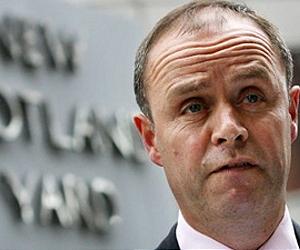
A government minster angrily hit out at Britain's top counter-terrorist policeman over remarks that cuts to police budgets would increase the risk of an attack.
John Yates, assistant commissioner at the Metropolitan Police, also known as Scotland Yard, described the recently elected government's 25 percent police budget cut as "eye-watering."
The cuts are part of the Conservative Party and Liberal Democrat Party coalition government's budget reductions to all central departments and agencies, including police and the National Health Service, to help reduce the country's debt by $237 billion.
Yates reportedly told a private session of the annual conference of the Association of Chief Police Officers that the cuts would impair the fight against al-Qaida. The government would have to "accept a higher level of risk" of a terrorist attack, he said.
The Met's anti-terror budget is to be slashed by around $132 million and that of other forces in the United Kingdom by another $93 million.
The cuts come as London prepares to put on the 2012 Olympic Games, whose security remains a police priority, Yates said.
He also warned against diluting police powers to use the 28-day detention rule for terror suspects and to make it harder for police to gain surveillance orders.
Yates' comments come days before the anniversary of the July 7, 2005, London terrorist attacks. More than 50 people died when a bomb in a double-decker bus exploded in the afternoon, ripping the top off the vehicle and injuring dozens of shoppers and tourists on sidewalks.
Yates's comments infuriated Francis Maude, Cabinet Office minister who speaks for the prime minister's inner circle.
"I'd like to avoid public servants doing this kind of shroud waving in public," he said. "There is a special responsibility on all public servants to be really careful what we say and what we do."
Maude, Conservative member of Parliament, said all public servants had to be "damn sure" they had cut out waste.
"It's going to be pretty important for people who are managing big public services, like police forces, to focus on cutting out unnecessary costs, driving down costs, being as efficient as they possibly can before they even begin to contemplate talking about alarming the public in this kind of way."
Yates, 51, has 29 years in the police force. He took over the top anti-terrorist job in April 2009 after his colleague, Bob Quick, resigned following a security incident.
A journalist photographed Quick getting out of a car at the prime minister's London residence, No. 10 Downing Street, clutching open documents in his arms. Clearly visible and legible in the photograph were pages deemed secret and confidential.
Quick resigned after police brought forward a major anti-terrorism operation because it was concerned the information in the documents, if known to terrorist, might have been useful.
Maude, 56, is a past chairman of the Conservative Party and is sometimes called "The Enforcer" for his ability to ensure party members fall in line over policy.
Maude also openly backed Republican Party hopeful Sen. John McCain in his presidential campaign.
Maude led a delegation of Conservative members of Parliament to the Republican National Convention in St. Paul, Minn., in September 2008. He was quoted at the time as saying he was a "strong supporter" of McCain.
"But I think this is shaping up to be a very even race and we need to be in good shape with whoever wins the presidency. There is certainly a lot to be learnt from Obama, he's an interesting guy."
Share This Article With Planet Earth
