
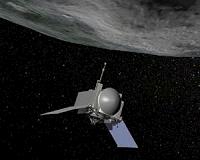
From over 2 million kilometers away, a powerful camera on NASA's Origins, Spectral Interpretation, Resource Identification, Security-Regolith Explorer (OSIRIS-REx) spacecraft will "see" the tiny asteroid Bennu for the first time, helping to guide the spacecraft to its destination.
Once there, its versatile focus mechanism will transform the camera from a telescope to a microscope, enabling it to examine tiny rocks while only hundreds of meters from the asteroid's surface.
This camera, called PolyCam, is part of an innovative suite of three cameras designed and built by the University of Arizona's Lunar and Planetary Laboratory (LPL). Together, these cameras will enable the OSIRIS-REx asteroid sample return mission to map the asteroid Bennu, choose a sample site and ensure that the sample is correctly stowed on the spacecraft.
The UA delivered the OSIRIS-REx CAMera Suite (OCAMS) instrument to Lockheed Martin Space Systems in Littleton, Colorado, today for integration onto the OSIRIS-REx spacecraft.
"The OCAMS instrument's three cameras, PolyCam, MapCam and SamCam, will be our mission's eyes at Bennu," said Dante Lauretta, principal investigator for OSIRIS-REx at the UA. "OCAMS will provide the imagery we need to complete our mission while the spacecraft is at the asteroid."
The largest of the three cameras, PolyCam, is a small telescope that will acquire the first images of Bennu from 2 million kilometers distance and provide high resolution imaging of the sample site.
MapCam will search for satellites and outgassing plumes around Bennu, map the asteroid in color and provide images to construct topographic maps. SamCam will document the sample acquisition event and the collected sample.
"The most important goal of these cameras is to maximize our ability to successfully return a sample," said OCAMS instrument scientist Bashar Rizk.
"Our mission requires a lot of activities during one trip – navigation, mapping, reconnaissance, sample site selection and sampling. While we are there, we need the ability to continuously see what is happening around the asteroid in order to make real-time decisions."
The OSIRIS-REx mission is scheduled to launch in September 2016 to study Bennu, a near-Earth and potentially hazardous asteroid. After rendezvousing with Bennu in 2018, the spacecraft will survey the asteroid, obtain a sample and return it to Earth.
