
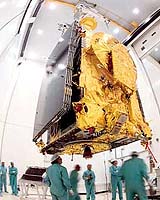
In June, Alcatel Space signed two new geostationary satellite contracts with China Satellite Communication Corporation (ChinaSat) and with the American operator PanAmSat.
Alcatel Space will design and produce the Chinasat 9 satellite, based on the Spacebus 4000 C1 platform. It will be fitted with 22 active Ku-band transponders for broadcast satellite services (BSS).
Chinasat 9 will weigh about 4,500 kilograms at liftoff and offer life power of about 11 kW. Positioned at 92.2 degrees East (or 134 degrees East), it will offer a design life of more than 15 years.
This satellite will be launched by a Chinese Long March rocket. Chinasat 9, a direct broadcasting satellite will enable ChinaSat to be the first state-owned Chinese company to provide satellite broadcast services in China.
Alcatel Space will also build PanAmSat's Galaxy 17 satellite. It will be the first European-built satellite in PanAmSat's fleet.
Based on Alcatel's Spacebus 3000 B3 platform, Galaxy 17 will be fitted with 24 Ku-band and 24 C-band transponders to provide television and telephone transmission services for North America.
It will weigh about 4,100 kg at launch, and offer beginning-of-life power of approximately 9.5 kW, plus a design life of 15 years.
Galaxy 17 is the 50th satellite in the range of geostationary communications satellites using the Alcatel Space Spacebus platform.
