
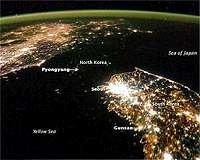
North and South Korea will hold a historic summit in the Demilitarized Zone next month after Pyongyang expressed willingness to give up its nuclear weapons in exchange for security guarantees, South Korea's national security adviser said Tuesday.
The North is open to "frank" talks with the United States on denuclearization and would suspend missile and nuclear tests while dialogue was under way, Chung Eui-yong said after returning from a meeting in Pyongyang with leader Kim Jong Un.
US President Donald Trump gave a cautious welcome to the announcement while Vice President Mike Pence said Washington would keep "maximum pressure" on Pyongyang until it takes concrete steps toward denuclearization.
"Possible progress being made in talks with North Korea," Trump tweeted. "For the first time in many years, a serious effort is being made by all parties concerned."
"The World is watching and waiting! May be false hope, but the U.S. is ready to go hard in either direction!"
North Korea is subject to multiple rounds of UN Security Council sanctions over its atomic and ballistic missile programs, and has long insisted that its "treasured sword" is not up for negotiation.
But it is willing to abandon the programs if its national security — and that of its leadership — is guaranteed, Chung said.
That remains a high threshold — Pyongyang has considered itself at risk of invasion by the United States since the Korean War ended in a ceasefire in 1953, leaving the two technically still at war.
But Chung said Kim is willing to discuss denuclearization with Washington — a crucial concession that could enable a dialogue.
Washington has long insisted Pyongyang take concrete steps towards denuclearization as a precondition.
"Whichever direction talks with North Korea go, we will be firm in our resolve," Pence said.
"The United States and our allies remain committed to applying maximum pressure on the Kim regime to end their nuclear program," he said. "All options are on the table and our posture toward the regime will not change until we see credible, verifiable, and concrete steps toward denuclearization."
– Olympics-driven rapprochement –
Tuesday's developments are the latest steps in a rapid Olympics-driven rapprochement on the peninsula. They follow a year of high tensions during which Pyongyang carried out its most powerful nuclear test to date, along with launches of rockets capable of reaching the US mainland.
Trump has dubbed Kim "Little Rocket Man" and boasted about the size of his nuclear button, while the North Korean leader called the American president a "mentally deranged US dotard."
But the Pyeongchang Winter Olympics in the South triggered an apparent transformation, with Kim sending his sister to the opening ceremony, sparking a flurry of cross-border trips as South Korean President Moon Jae-in tries to broker talks between Pyongyang and Washington.
North and South agreed to hold a summit in late April in Panmunjom, the truce village in the DMZ, Chung said after leading the most senior delegation to travel North for more than a decade.
It will be the third meeting between the leaders of North and South, but the first to take place in the DMZ after summits in Pyongyang in 2000 and 2007.
The North "made clear that there is no reason to own nuclear (weapons) if military threats towards the North are cleared and the safety of its regime is guaranteed," Chung said.
Pyongyang "expressed willingness to have frank dialogue with the US to discuss the denuclearization issue and to normalise North-US relations," he added, and said there would be no provocations such as nuclear or ballistic missile tests while dialogue was under way.
"Also, the North promised not to use atomic weapons or conventional weapons towards the South," he told reporters, adding that Seoul and Pyongyang would set up a hotline between the leaders.
Kim also said he would "understand" if the South goes ahead with delayed joint military exercises with the US that usually infuriate Pyongyang, a senior official at the South's presidential office added.
– 'Very important breakthrough' –
The visit produced "a very important breakthrough," said Cheong Seong Chang of Sejong Institute think tank, calling the results "an important first step towards stably managing the North's nuclear and missile threats, preventing war on the Korean peninsula and building political and military trust."
He cautioned that the definition of "military threats" the North wanted to see removed was "up for interpretation" but said he believed Washington and Pyongyang "would soon begin serious dialogue."
Previous negotiations have ultimately foundered, however. Six-party talks, grouping the two Koreas, Russia, China, Japan and the US, and offering the North security and economic benefits in exchange for denuclearization, broke down almost a decade ago.
North Korean state media pictures of the delegation's extended meeting with Kim in Pyongyang showed the North's leader in a jovial mood, smiling and shaking hands enthusiastically.
"Hearing the intention of President Moon Jae-In for a summit from the special envoy of the south side, he exchanged views and made a satisfactory agreement," the North's official news agency KCNA said earlier.
Rodong Sinmun newspaper, the mouthpiece of the ruling Workers Party, devoted its entire front page to the visit.
The trip came after the North's leader sent his sister, Kim Yo Jong, to the Winter Games, the first visit to the South by a member of the North's ruling dynasty since the end of the 1950-53 Korean War.
Kim also invited Moon to a summit in Pyongyang but the South Korean leader said the "right conditions" were needed.
UN offers to help advance North Korea talks
United Nations, United States (AFP) March 6, 2018 –
The United Nations on Tuesday welcomed plans for a summit between North and South Korean leaders and said it was ready to help advance talks on ending the crisis over Pyongyang's drive to develop nuclear weapons.
"Obviously, we are encouraged by these discussions," said UN spokesman Stephane Dujarric. "Anything that can further reduce military tensions is welcome."
The leaders of North and South Korea will next month hold a historic summit at the truce village of Panmunjom, said an envoy from the Seoul government following talks in Pyongyang with leader Kim Jong Un.
South Korea's national security adviser, Chung Eui-yong, said Pyongyang was open to discuss getting rid of its nuclear program with the United States in exchange for security guarantees.
"We reiterate our commitment to further assist in this process with the governments concerned in any way," the UN spokesman told reporters.
UN Secretary-General Antonio Guterres in December sent his political chief, Jeffrey Feltman, to Pyongyang to urge North Korea to open a dialogue on ending the crisis.
Feltman, however, was then told by Pyongyang that "now was not the time" for dialogue, even if the North Korean officials agreed it was important to avoid war.
The UN Security Council has imposed tough economic sanctions aimed at choking off revenue to Pyongyang's military programs after Kim's regime carried out a sixth nuclear test and a series of advanced missile launches.
China, Pyongyang's sole ally, and Russia argue that sanctions alone will not push North Korea to change course and have repeatedly called for stepping up diplomatic efforts to achieve a solution.
UN chief says time to seize the opportunity for Korean talks
United Nations, United States (AFP) March 6, 2018 –
United Nations Secretary-General Antonio Guterres on Tuesday urged all sides to seize the opportunities of a planned summit between North and South Korea, as well as future talks on ending Pyongyang's nuclear weapons drive.
Guterres said he was encouraged by the advances made to hold the summit and discuss future talks on the denuclearization of the Korean peninsula.
"The latest developments are further steps forward in laying the foundation for the resumption of sincere dialogue, leading to sustainable peace and denuclearization on the Korean peninsula," his office said in a statement.
Guterres "is encouraged by the advances made during the latest inter-Korean talks, particularly the agreement to hold a summit meeting soon, to further reduce military tensions, and to discuss denuclearization in future talks with all relevant parties," it added.
"He stresses the need to protect the momentum and seize the opportunities available to find a peaceful path forward."
The leaders of North and South Korea will next month hold a historic summit at the truce village of Panmunjom, said an envoy from the Seoul government following talks in Pyongyang with leader Kim Jong Un.
South Korea's national security adviser, Chung Eui-yong, said Pyongyang was open to discuss getting rid of its nuclear program with the United States in exchange for security guarantees.
Guterres offered UN help to the governments concerned to address the crisis.
In December, Guterres dispatched his political chief, Jeffrey Feltman, to Pyongyang to urge North Korea to open a dialogue on ending the crisis.
Feltman, however, was then told by Pyongyang that "now was not the time" for dialogue, even if the North Korean officials agreed it was important to avoid war.
The UN Security Council has imposed tough economic sanctions aimed at choking off revenue to Pyongyang's military programs after Kim's regime carried out a sixth nuclear test and a series of advanced missile launches.
China — Pyongyang's sole ally — and Russia argue that sanctions alone will not push North Korea to change course and have repeatedly called for stepping up diplomatic efforts to achieve a solution.
