
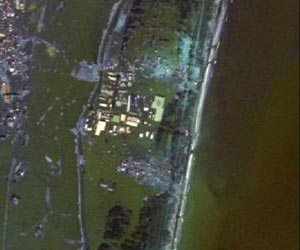
Kaori Ohashi watched with horror as the debris-heavy waves of mud swallowed houses and bulldozed fields, and then rushed towards the nursing home where she works.
She saw cars thrown from the roads by the raging water — their drivers still inside. Other victims desperately clung to trees before the waves generated by the biggest earthquake in Japan's history dragged them under.
"I thought my life was over," Ohashi told AFP, as she recounted the tale of two harrowing nights trapped inside the home with 15 staff members — and 200 elderly residents with severe dementia — after Friday's twin disasters.
Ohashi, a 39-year-old mother of two, is now staying in an emergency shelter at a local school gymnasium in Sendai, the capital of hard-hit Miyagi prefecture, with about 400 other evacuees.
Each time one of the multiple daily aftershocks rattles the building, she jumps to wrap her body around her two-year-old daughter.
On Friday, as the first floor of the facility quickly filled with murky water, she and her colleagues raced to bring the elderly to the second and third floors.
"During all that time, we were feeling large aftershocks. Snow started to fall and it became dark. We lost power. I thought 'This is a nightmare'," Ohashi said.
Though Ohashi tried to remain strong for those in her care, the harsh chill of winter and the sinking feeling of isolation quickly depressed her, and she feared none of them would survive.
She and her fellow workers kept busy by tending to the elderly, feeding them each a small portion of canned tuna and a little bread by torchlight.
In the pitch dark, the staff had to help the elderly use the toilet and then laid mats on the hard floor so they could sleep.
"The residents were scared. I don't think they knew it was a tsunami, but some people were scared because the rooms were dark and cold," she said.
"Many people noticed that something was different and they couldn't sleep until 2:00 or 3:00 am. We tried to comfort them by talking to them," she added.
"We were in total isolation. We were afraid to leave the building because tsunami and earthquakes could hit again at any time."
Ohashi was able to reach her 12-year-old son on a mobile phone, and said she trusted that her two-year-old daughter would be cared for at her daycare centre.
Almost 24 hours after the tsunami struck, Ohashi said she again began to have some hope. The waters receded, and a rescue helicopter hovered above the facility.
Two rescuers pledged that help was on the way, and urged Ohashi to stay strong.
On Sunday, a team of emergency personnel came to the nursing home. They cleared a path for the elderly to escape. They then conducted medical check-ups on the residents before transporting them to be with their relatives.
A near-miracle — none of them was injured.
"A rescue nurse came to me and said, 'You have done well.' It was only then that I lost it and cried hard," Ohashi said.
She was reunited with her family on Sunday at the shelter in Sendai.
"When I telephoned my son soon after the earthquake, I told him that I would eventually see him again. I was losing hope. But then I told myself that I had promised my son. I had to survive," Ohashi said.
"I was so glad to see my son and daughter. I didn't have words to tell them. I was so glad," she said.
Ohashi's home is still standing, but everything inside — furniture, dishes, and appliances — were violently thrown around by the quake.
"What we lack now is information. We don't know the progress of search-and-rescue. We don't know what will happen to us. We just don't know what the future holds for us," she said.
"The future is uncertain. This is scary."
Share This Article With Planet Earth
