
Amid rising US-Lebanon tensions, a top US lawmaker asked the Pentagon in a letter released Wednesday for assurances that military aid from Washington is not indirectly helping Hezbollah.
House Armed Services Committee chairman Ike Skelton, a Democrat, wrote Defense Secretary Robert Gates seeking a formal briefing on Lebanon, including "measures we have in place" to safeguard military aid.
Skelton said a deadly clash between Lebanese and Israeli forces along the countries' shared border "has me concerned that our policy with Lebanon may be counter-productive."
"I am concerned that the training and equipment we have provided the LAF (Lebanese Armed Forces) for the purposes of counter-terror may in fact be used by the LAF against the Israelis," said the lawmaker.
"I am also concerned of reports that the LAF is collaborating with Hezbollah and that Hezbollah is, as a result, an indirect recipient of our aid," Skelton said in the letter, which was released by his committee.
His comments came after another senior Democratic lawmaker, House Foreign Affairs Committee Chairman Howard Berman, said he would freeze 100 million dollars in military aid to Lebanon after the clash, which left four dead.
Berman, in a statement, said he could not be sure the Lebanese armed forces were not working with the Shiite militant movement Hezbollah, which Washington lists as a terrorist organization.
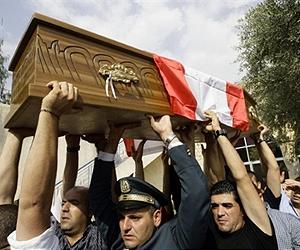
The Israel-Lebanon border has been tense since the exchange of fire on August 3 that killed two Lebanese soldiers, a Lebanese journalist and an Israeli officer.
The standoff was sparked when Israeli troops tried to cut down a tree on the border, prompting Lebanese soldiers to open fire.
News of Skelton's request came as Lebanon's defense minister, Elias Murr, lashed out at the US military aid freeze.
"Whoever sets as a condition that the aid should not be used to protect Lebanon's land, people and borders from the (Israeli) enemy can keep their money," Murr told a news conference.
An adviser to Lebanese President Michel Sleiman has also criticized the US decision but said that support for the army was central to upholding Lebanon's sovereignty.
"It is time the Lebanese army be adequately armed, and we are counting on the friends of Lebanon to help the army," Nazem Khoury told AFP.
earlier related report
US lawmaker cuts 100 million dollars aid to Lebanon military
Washington (AFP) Aug 10, 2010 –
A top US congressman has blocked 100 million dollars in aid to Lebanon's military, saying he cannot be sure the country's armed forces are not working with Hezbollah.
The news sparked criticism from an aide to the Lebanese president, who said the money was needed to underpin the country's sovereignty.
Howard Berman, the Democratic chairman of the House Foreign Affairs Committee, said in a statement Monday that he had placed the hold on August 2, pointing to last week's deadly clash between Israeli and Lebanese troops along the countries' shared border.
"Until we know more about this incident and the nature of Hezbollah influence on the LAF (Lebanese Armed Forces) — and can assure that the LAF is a responsible actor — I cannot in good conscience allow the United States to continue sending weapons to Lebanon," Berman said.
"The incident on the Israel-Lebanon border only one day after my hold was placed simply reinforces the critical need for the United States to conduct an in-depth policy review of its relationship with the Lebanese military," he added.
Relations between Israel and Lebanon have been strained in the wake of the deadly exchange of fire last week that killed two Lebanese soldiers and a journalist, as well as an Israeli officer.
The standoff was sparked when Israeli troops tried to cut down a tree on the border, prompting the Lebanese to fire on them.
Meanwhile, State Department spokesman Philip Crowley said the United States was not planning "to reevaluate our current military cooperation with Lebanon in light of this incident," adding that military cooperation with Lebanon remains in US interests.
"We are not aware that there was any US equipment used during the incident," he told reporters.
"We do have training programs with Lebanon. It's hard to say whether those who were directly involved in this incident were a part of any training program."
Representative Eric Cantor earlier warned that the lines between the Shiite movement and Lebanon's armed forces had become "blurred."
"The days of ignoring the LAF's provocations against Israel and protection of Hezbollah in southern Lebanon are over," said Cantor, the number two Republican in the House of Representatives.
"Lebanon cannot have it both ways. If it wants to align itself with Hezbollah against the forces of democracy, stability and moderation, there will be consequences," said Cantor, a fierce defender of Israel.
Cantor said the United States had provided roughly 720 million dollars since 2006 in military aid "to build up a Lebanese fighting force that would serve as a check on the growing power of the radical Islamist Hezbollah movement."
But, he said, "for the past few years, the US and the international community looked the other way as the lines between Hezbollah and the Lebanese military and government became blurred."
In Beirut, Nazem Khoury, an advisor to President Michel Sleiman, said "it is in the interest of those who claim to defend Lebanon's sovereignty that Lebanon have a strong army.
"The United States says it supports that sovereignty, but these statements should also be translated into acts," he added.
"It is time the Lebanese army be adequately armed, and we are counting on the friends of Lebanon to help the army.
Share This Article With Planet Earth
