
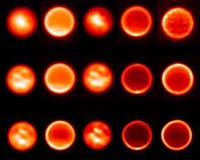
Using a ground-based telescope in the Chilean mountains, astronomers have resolved new atmospheric details on Saturn's moon, Titan, to image features only 120 miles across. The origin of atmospheric patches, particularly in the Southern hemisphere, is not presently understood, but will be a major topic to study when a surface probe descends later this year.
Titan, the largest moon of Saturn was discovered by Dutch astronomer Christian Huygens in 1655 and certainly deserves its name. With a diameter of no less than 5,150 km, it is larger than Mercury and twice as large as Pluto. It is unique in having a hazy atmosphere of nitrogen, methane and oily hydrocarbons. Titan's atmospheric pressure near its surface is 60 percent greater than on Earth at sea level.
Although it was explored in some detail by the NASA Voyager missions, many aspects of the atmosphere and surface still remain unknown. Thus, the existence of seasonal or diurnal phenomena, the presence of clouds, the surface composition and topography are still under debate. There have even been speculations that some kind of primitive life (now possibly extinct) may be found on Titan.
Titan is the main target of the NASA/ESA Cassini/Huygens mission, launched in 1997 and scheduled to arrive at Saturn on July 1, 2004. The ESA Huygens probe is designed to enter the atmosphere of Titan, and to descend by parachute to the surface.
To prepare cartographic views of the moon, ground-based telescopes like the European Southern Observatory's Very Large Telescope (VLT) at the Paranal Observatory in Chile now is studying the resolved disc of Titan with high sensitivity and increased spatial resolution.
Scientists would like to know the origin of the atmospheric patches imaged on Saturn's moon.
These new extraordinary images show details of the order of 200 km (120 miles) on the surface of Titan (a nominal resolution of 1/30th arcsec ).
By changing a filter, the telescope can effectively zoom down beneath Titan's heavy cloud cover to various depths from the surface. Images of Titan were obtained through 9 narrow-band filters, sampling near-infrared wavelengths with large variations in methane opacity. Titan has a large amount of hydrocarbons, both on the surface in what is predicted to be lakes of sludge and also in the atmosphere as methane.
