
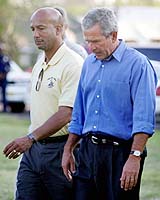
US President George W. Bush, facing his worst ever poll numbers and sharp criticism of Washington's response to Hurricane Katrina, opened his third tour of storm-ravaged areas on Sunday.
Bush was to spend the night aboard the USS Iwo Jima, an 844-foot amphibious assault ship that has served as a command-and-control center for relief efforts. Aboard the vessel on Monday, he will be briefed on the recovery.
Afterward, he was to tour this flooded city in a military truck before visiting nearby Gulfport Mississippi, and was due back at the White House late Monday.
The president was welcomed by military officials in charge of the relief efforts as well as by New Orleans Mayor Ray Nagin, who had previously attacked Washington for its response to Katrina.
Bush traveled here after marking the fourth anniversary of the September 11 terrorist strikes, a disaster that transformed his presidency and briefly made him one of the most popular US leaders ever.
But domestic political fights, the war in Iraq, and what critics charge was Washington's too-little, too-late response to Katrina have sent his approval ratings tumbling to their worst levels since he took office in January 2001.
A poll by Newsweek magazine found that just 38 percent approve of his job performance, while 52 percent of respondents no longer trust him to make the right decisions in a foreign or domestic crisis, versus 45 percent who do.
A separate poll by Time magazine suggested that 61 percent of Americans thought the government should cut its spending in Iraq to help pay for the reconstruction of hurricane-shattered New Orleans and the surrounding area.
Bush said nothing as he left the White House, striding somberly toward his Marine One helicopter in a blue blazer, blue shirt and dark-gray pants with a group of advisers trailing behind. He gave waiting journalists a cursory wave before boarding the chopper.
After a sluggish early reaction to Katrina, Bush has taken aggressive steps to portray himself as concerned and in charge, visiting the area twice and sending top aides – including Vice President Dick Cheney – to the region.
And Homeland Security Michael Chertoff last week removed Federal Emergency Management Agency chief Mike Brown – accused of incompetence and of padding his resume – and put Vice Admiral Thad Allen from the US Coast Guard in charge of the relief operation.
The White House has let it be known that Bush requested and has been receiving daily briefings on Katrina relief efforts in addition to his regular intelligence briefings on issues like Iraq and terrorism.
On Saturday, a White House spokesman said Bush was also keeping track of Hurricane Ophelia, which could hit southern US states early Tuesday, according the US National Hurricane Center.
The White House has also said the president and First Lady Laura Bush would make "a significant donation" of money to relief efforts but has declined to say how much.
And Bush, in a rare admission of fallibility, has said that the results of early relief efforts were "unacceptable," but has rejected calls for an independent investigation like the commission that looked into intelligence failures leading up to the September 11, 2001 attacks.
Instead, he has promised to look into what went wrong – but only after relief and reconstruction efforts are over, even as he has publicly criticized Washington's initial response.
Time magazine reported Sunday that Bush had grown angry with military and disaster officials during a video-conference last week, barking: "I know y'all are trying as hard as you can, but it ain't cuttin' it."
