
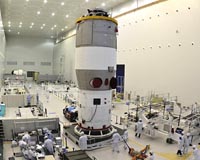
China's Tiangong 2 space laboratory will launch soon. At the time of writing, there is no official word on a launch date, but the launch is expected well before the end of September. There has been extensive speculation of the upcoming Tiangong 2 program in recent years, and it's fair to say we have not learned much more in recent weeks.
China is still keeping its cards close to its chest, but the overall media coverage seems to be no worse than any other recent missions. Television reports have covered the upcoming launch, but we have not seen any interior shots of the module. Is the layout the same as Tiangong 1? It's probably mostly similar, but there could be some differences.
From the outside, Tiangong 2 looks similar to its predecessor, but China claims that it has a refuelling system. This will be tested when a Tianzhou cargo spacecraft makes it maiden launch and docks with Tiangong.
China has announced plans to launch the Shenzhou 11 spacecraft to Tiangong 2, carrying a crew of two astronauts. As usual, their identities remain cloaked at this stage, and we will probably not know their names until shortly before they launch. Expeditions to Tiangong 1 featured three astronauts.
The smaller crew will allow logistics to be extended for longer missions, and also allow China to experiment with the performance of a smaller crew. We expect Shenzhou 11 to launch within a few weeks, presenting a relatively short turnaround for launches.
That will demonstrate more efficient practices at the launch site and also in space. Launching two or more connected missions quickly is a critical skill for Earth Orbit Rendezvous missions to the Moon. A crewed spacecraft could dock with a booster rocket in low Earth orbit before the booster propels it into deep space.
The launch of Tiangong 2 follows in the wake of the high-profile G20 summit that China recently hosted, and could serve as a reminder of China's technological and industrial power. But this analyst does not believe that there has been any premeditated link between these two events.
It's worth remembering that recent days have been troubling for space launches. China suffered a final stage underperformance from a Long March4C that caused its satellite payload to crash to Earth, while SpaceX suffered from an explosion on the launchpad.
Such incidents give all rocket people the jitters, regardless of the hardware they fly. But the Long March 2F that will launch Tiangong 2 has an excellent track record.
The rocket carrying Tiangong 2 is actually the Long March 2F/G variant. This has a modified payload fairing designed to accommodate the Tiangong module. It only flew once before, when Tiangong 1 was launched in 2011.
It seems probable that this next launch will be its last. There will be no more Tiangong laboratories after Tiangong 2, and this rocket is too small to loft modules or cargo ships for China's future space station.
The next Tiangong saga is approaching. Let's enjoy the show.
