
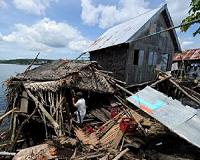
Thousands of people heading home for Christmas in the Philippines were stranded on Sunday by Tropical Depression Kai-Tak, a day after the storm killed three people as it pounded the nation's eastern islands.
The storm has weakened, with gusts of up to 90 kilometres (56 miles) an hour, after cutting off power and triggering landslides in a region devastated by Super Typhoon Haiyan four years ago, state weather forecasters said.
Disaster officials on Sunday warned that more floods and landslides were possible and said 15,500 passengers were stranded because ferry services remained suspended in parts of the central Philippines.
"I've been stranded for three days, sleeping in the bus, and I just want to get home to my family for Christmas," Eliaquin Pilapil, a 55-year-old farmer, told AFP from a port in the town of Matnog in the eastern province of Sorsogon.
"We're given food once or twice a day and some of the passengers here are running out of money."
The Christmas holidays are a busy travel season in the mainly Catholic Philippines, with people heading home to the provinces.
The archipelago nation is battered by about 20 major storms each year.
Kai-Tak, initially classified as a tropical storm, killed three people, injured 19 and forced 87,700 people from their homes when it tore across the eastern islands of Samar and Leyte on Saturday.
The two islands bore the brunt in 2013 of Super Typhoon Haiyan, which left more than 7,350 people dead or missing.
Kai-Tak toppled power lines in 39 towns or cities and damaged roads and bridges, the national disaster agency said.
In the Leyte city of Tacloban, it brought flash floods of up to 1.5 metres (five feet) and strong winds that left the city without power and water, according to its disaster office chief.
"The storm moved so slowly that it brought so much rain to our city. The floods resulted from four days of rain," Ildebrando Bernadas, head of Tacloban's disaster risk reduction office, told AFP.
Bernadas said 82 percent of Tacloban's districts were flooded.
The storm also damaged farms and crops, bringing more misery to people who had been recovering from Haiyan's destruction.
"We had a phobia from (Haiyan) which destroyed our coconut trees. We planted lettuce and eggplant but the new storm took them away too. It's devastating," Remedios Serato, a 78-year-old farmer in Leyte, told AFP.
Three dead, 77,000 flee as storm pounds Philippines
Tacloban, Philippines (AFP) Dec 16, 2017 –
At least three people were killed and tens of thousands were driven from their homes by floods as Tropical Storm Kai-Tak pounded the eastern Philippines on Saturday, cutting off power and triggering landslides, officials said.
Kai-Tak, packing gusts of up to 110 kilometres (62 miles) an hour, hit the country's third-largest island Samar in the afternoon and tore through a region devastated by Super Typhoon Haiyan four years ago, the state weather service said.
Local officials reported three deaths on neighbouring Leyte island — a two-year-old boy who drowned in the town of Mahaplag, a woman buried by a landslide and another person who fell into a flooded manhole in Ormoc city.
Samar and Leyte, with a combined population of about 4.5 million, had borne the brunt of Haiyan in 2013, which left more than 7,350 people dead or missing.
Bus driver Felix Villaseran, his wife and four children hunkered down in their two-storey house in the Leyte city of Tacloban along with 11 relatives whose homes were flooded from incessant rain.
"We have yet to shake off our phobia. I hope to God we don't have a repeat of that," Villaseran, who lost 39 cousins in the Haiyan onslaught, told AFP by telephone.
"My missus stockpiled on groceries before the storm hit, but since we also have to feed these three other families we're now running low on food," he added.
– 77,000 evacuated –
Military trucks drove through rising floodwaters on Samar and Leyte to rescue trapped residents, with more than 77,000 people now in evacuation centres, local officials said.
Strong winds toppled trees and power pylons, knocking out power throughout the region while floods, small landslides and rock falls blocked roads and buried some homes, local officials and witnesses said.
Farmland in the mainly rural region was also under water, while seven people were injured by landslides and flying objects, the regional civil defence office said in a report.
A spokeswoman for the national government's National Disaster Risk Reduction and Management Council told AFP it was trying to confirm reports of two other deaths from landslides and floods on the islands of Biliran and Dinagat.
"It was like a flashback again for residents of Tacloban city," its vice mayor Sambo Yaokasin told Manila television station ABS-CBN by telephone, referring to the Haiyan disaster.
The station broadcast images of flooded streets and corrugated iron roofing sheets flying off homes.
"Nearly half the villages here are flooded," Marcelo Picardal, vice governor of Eastern Samar province told ABS-CBN in a telephone interview.
Three other people were missing in Ormoc after being swept away by floods on Saturday, city mayor Richard Gomez told CNN Philippines television in an interview.
"We need a lot of water and a lot of blankets," Gomez added, citing widespread flooding that may have contaminated the tap water system of the city of 200,000 people.
The state weather service said more heavy rain was expected in the eastern Philippines in the coming hours with Kai-Tak forecast to slice across the rest of the central Philippines over the weekend.
Ferry services on the storm's path were suspended due to rough seas, the civil defence office in the area said.
About 20 typhoons or weaker storms either make landfall in the Philippines or reach its waters each year, bringing annual misery and death and consigning millions of survivors to perennial poverty.
Beyond wind speed: A new measure for predicting hurricane impacts
Six major hurricanes that engulfed the Atlantic Basin in 2017 were a devastating reminder of the vulnerability of coastal communities, where more than half the U.S. population resides.
What if there was a better way to forecast and communicate these storms' damaging economic impacts, before they happen?
Colorado State University civil engineers have developed an innovative new approa … read more
