
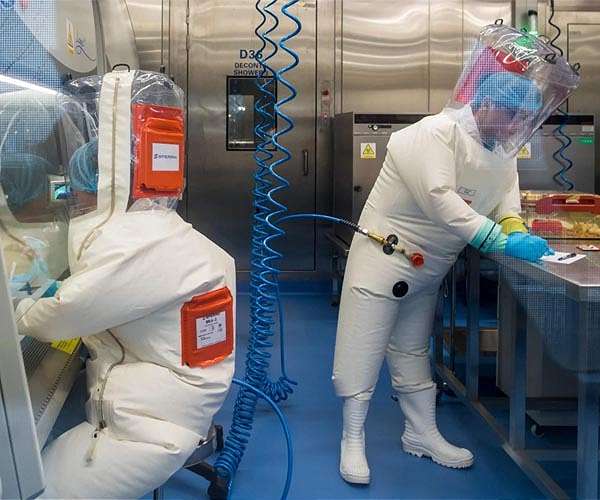
A team commissioned by the World Health Organization to investigate the source of the coronavirus in Wuhan in January concluded that it was "extremely unlikely" that the pathogen originated in a top-security lab in the ground-zero Chinese city.
And a WHO report — seen on Monday by AFP before its official release — found that Covid-19 was most probably first passed to humans from a bat through an intermediary animal, with investigators all but ruling out the laboratory leak theory.
However, that may not completely lay to rest a notion that was brought into the mainstream by former US president Donald Trump and others, and which gained oxygen as Chinese secrecy and the inability to pinpoint a natural source raised suspicion.
Here are some key facts about the Wuhan Institute of Virology's lab:
– High security –
The institute houses a lab with a biosafety rating of "P4" — the highest possible — which is determined by the level of danger and resulting security measures posed by the pathogens studied there. P4-level pathogens include those which cause diseases such as Ebola.
The P4 lab is Asia's first and was built at cost of 300 million yuan ($42 million), opening in 2018. It houses the largest virus bank in Asia, with more than 1,500 strains.
A P3 lab — the biosafety level that includes coronaviruses — has been in operation at the site since 2012.
– Critical research –
The institute studies some of the world's most dangerous diseases and previously conducted extensive investigations into the links between bats and disease outbreaks in China.
Its scientists helped shed light on the Covid-19 pathogen in the early days of the outbreak in Wuhan.
In February of 2020, researchers there published work concluding that the genetic makeup of the new virus was about 80 percent similar to the SARS coronavirus, and 96 percent identical to a coronavirus found in bats.
Many scientists think the virus that causes Covid-19 originated in bats and may have jumped to people via another still-undetermined mammal, and gained traction among humans in late 2019 at a wet market in Wuhan where wildlife species were sold as food.
Liang Wannian, head of the Chinese contingent of the WHO mission, said at the mission's conclusion that animal transmission remained the likely route, but "the reservoir hosts remain to be identified".
– The 'lab leak' –
Previous US diplomatic cables reported by the Washington Post had revealed concern in Washington about safety standards in the Wuhan facility.
Shi Zhengli, one of China's leading experts on bat coronaviruses and deputy director of the P4 lab, further raised eyebrows in a June 2020 interview with Scientific American magazine in which she said she was initially anxious over whether the virus had leaked from her lab.
Subsequent checks revealed that its gene sequence differed from viruses held at the lab, and Shi said she would "bet her life" that there was no leak, according to Chinese state media.
But the theory was kept alive by the likes of Trump and his former Secretary of State Mike Pompeo. Pompeo insisted last year that there was "significant evidence" that the virus came from the lab, while offering no such proof.
Prominent global publications including Le Monde and the Wall Street Journal, as well as scientists at Harvard and Stanford, also kept the theory alive by publishing articles or reports saying it was a possibility.
– WHO conclusions –
The WHO team's mission to Wuhan included a stop at the virology institute, where they met with Chinese scientists including Shi.
The team's leader Peter Ben Embarek said at the end of the mission that the lab-leak theory was "extremely unlikely" and "not in the hypotheses that we will suggest for future studies."
The mission found nothing to overturn the general consensus within the scientific community that the pathogen appeared to be of natural origin.
– Doubts persist –
But questions about the lab persist, with critics noting that the WHO team's investigative hands may have been tied by strict parameters set by its Chinese hosts.
Team members spent only four hours at the virology institute, just an hour at the wet market, and several days inside their hotel without venturing out into the city.
In a subsequent interview with AFP, Embarek voiced "frustration" at lack of access to raw data while in China.
US national security adviser Jake Sullivan voiced "deep concerns" over how the mission was carried out and urged China to "make available its data from the earliest days of the outbreak".
WHO report says 'very low' chance of frozen food Covid-19 origin
Beijing (AFP) March 29, 2021 –
The chances that Covid-19 emerged in Wuhan because of imported frozen food are "very low", international health experts said Monday, casting doubt on one of the main theories China has embraced for the cause of the first coronavirus outbreak in late 2019.
China has questioned the initial assumption the virus originated in the central city as it tries to deflect claims it mishandled the early outbreak, instead focusing on other potential causes as the country began to recover.
The "probability of a cold-chain contamination with the virus from a reservoir is very low," a team of World Health Organization-appointed and Chinese scientists said in a long-awaited report obtained by AFP before its official release.
It also said the introduction of the virus into China through frozen food would have been "extraordinary" in December 2019, given the virus had not been detected elsewhere at that time.
While there remained a "possible" chance of such a transmission, it said there was no conclusive evidence that frozen food played any role in the virus' spread.
The report instead concluded it is very likely Covid-19 first passed to humans from a bat through an intermediary animal, and all but ruled out a theory the virus could have leaked from a high-security lab in central China.
After the outbreak, explanations floated by Chinese officials and state-media have ranged from a conspiracy theory that US soldiers imported the virus in the 2019 World Military Games in Wuhan, to the frozen food theory after a series of outbreaks linked to workers who handled frozen goods.
– Introducing doubt –
The theory that the virus was originally imported into China could help Beijing in its battle against the criticism over the outbreak, experts say.
"The goal is probably to introduce enough doubt to make people question the origin of the virus," Adam Ni, analyst at the China Policy Centre in Canberra, Australia, told AFP.
At the same time, "there is this dynamic where the harder political leaders in some countries try to blame China for Covid-19, the harder that Beijing tries to put up counter-narratives," Ni said.
The nationalist Global Times published a report in December that asked in its headline, "Could cold chain imports have sparked Wuhan early Covid-19 outbreak?"
The newspaper drew a link between imported frozen and refrigerated food sold at the Huanan seafood market and the coronavirus, citing local scientists who called the theory "plausible" and "possible."
Meanwhile, local officials around the country have tested hundreds of thousands of imported food samples, publishing alerts whenever a sample tests positive for traces of the coronavirus.
– 'Bit of a leap' –
Despite reports in Chinese state media, there is still little evidence that coronavirus carried on cold-chain products can infect humans, scientists say.
Chinese researchers have said outbreaks among Beijing market workers and dock workers in eastern China's Qingdao were linked to virus particles on frozen fish.
The WHO report also said the only epidemiological link which could be established in the Qingdao cases "was exposure to [the virus] on the surface of cold-chain packaging."
"There's a remote possibility that something could happen," Richard Sugrue, a virologist at Nanyang Technological University in Singapore told AFP.
But Sugrue said "it's a bit of a leap to say that (as) this has been detected in frozen food that that could be a route of transmission."
Leong Hoe Nam, an infectious disease specialist at Singapore's Mount Elizabeth Novena Hospital, agreed that it was unlikely cold-chain imports could have sparked the initial outbreak in Wuhan.
"Cold chain food is still being brought into China, Singapore, Taiwan and all other countries with a good control of the virus," Leong told AFP.
"And yet it happens only in two places in China."
