
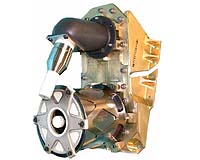
Busek announces the historic launch and successful in-space operation of its BHT-200 Hall Effect Thruster. The Busek Thruster, part of the Microsatellite Propulsion Integration (MPI) Experiment, was integrated on the Air Force Research Laboratory's (AFRL) TacSat-2 satellite, under the direction of the DoD Space Test Program, which launched December 16, 2006 from the NASA Wallops Flight Facility on Wallops Island, VA.
The thruster represents the first US-designed and built Hall Effect Thruster in orbit, and serves as a demonstration of advanced US electric propulsion technology. Hall Effect Thrusters use ionized Xenon gas (a plasma) that is accelerated electrostatically by an induced electric field. Hall Effect Thrusters provide multiple advantages to the satellite industry and have the potential to displace many traditional propulsion systems.
With five to 10 times greater efficiency in propellant use than conventional chemical thrusters, Hall Effect Thrusters enable commercial and military satellite operators to cut launch weight and associated costs while maintaining existing performance standards. Other benefits include a greater range of satellite maneuverability, effectively increasing the operational utility of satellite systems, and enabling an "on-demand" satellite service-provider model.
The development of Busek's BHT-200 and its source of electrons, the BHC-1500, 3mm hollow cathode, were initiated by the AFRL through an SBIR contract. The flight hardware was completed in 2005 and delivered to Northrop Grumman Space Technology (NGST) in early in 2006.
NGST served as the overall propulsion system integrator and delivered the propulsion system to the AFRL VS at Kirtland AFB which integrated the system on the spacecraft. The Hall Effect Thruster has a total efficiency of 43%, and delivers 13mN thrust, 1375sec specific impulse at its nominal input power of 200W.
Operational testing of TacSat-2 and its components is ongoing by the Department of Defense, the AFRL, and the Office of Force Transformation. TacSat-2 is the first in a series of satellites to demonstrate the Air Force's Operationally Responsive Space (ORS) program and is a demonstration platform for the future rapid deployment of small, flexible satellite systems.
