
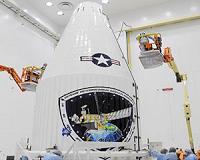
Artificial satellites that monitor the Earth's weather and climate are usually referred to as "weather" or "meteorological" satellites. These space systems may be found in sun-synchronous (near-polar) orbits and in geosynchronous (near-equatorial) orbits.
A sun-synchronous satellite can cover the entire Earth via periodic overflights (asynchronously, at an altitude roughly between 700 and 900 km) of any location of interest, whereas a geosynchronous satellite may hover over the equator at an altitude of 35,800 km and continuously view the same spot indefinitely.
Such satellites can observe a number of weather, climate and human-induced phenomena such as clouds, cloud systems, city lights, fires, pollution effects, auroras, dust storms, snow and ice cover, and boundaries of ocean currents. Weather satellites have commercial, civil and military applications. Most people check their local weather forecast on a daily basis, because meteorological events impact our daily routines.
However, most of us are not familiar with the military implications of tracking weather events and daily climatological changes. Such information is very important for efficient operations run by the various armed services. As such, specifications for the US's Defense Meteorological Satellite Program (DMSP) has produced the most sophisticated and accurate weather satellites. Sensors on these spacecraft can detect objects such as oil tankers from 900 km away.
Development of the DMSP can be traced back to the 1960s in order to provide important weather and climate data to the military for more effective operations. In the early days of the program, knowledge of DMSP's existence was limited to "need-to-know" personnel due to political concerns about simultaneously funding both civil and military weather satellite programs.
The DMSP has provided a great deal of important data for the military, but it has had its share of recent challenges. For example, in February of 2015, the 13th program satellite (DMSP-13), which was launched in 1995, exploded while transiting a space debris field in sun-synchronous orbit. The USAF estimated this field might have contained more than 100 large fragments and over 50,000 objects that were smaller than 1 millimeter. This event highlighted the growing threat of space debris encounters in low earth orbits.
Just last month satellite controllers lost the ability to control DMSP-19. This spacecraft is the Air Force's newest weather satellite, having been launched in April 2014. Ground controllers are hopeful that control can be re-established.
The current DMSP constellation includes two primary satellites and two backup satellites. Lost access to DMSP-19 has led the Air Force to reassign a 10-year-old backup satellite, DMSP-17, into a primary role.
As a final note, last year Congress opted to terminate the DMSP program. Thus, the Air Force is not expected to launch another DMSP satellite. In 2017, a replacement program is to be demonstrated.
