
The NASA funded
Lunar Prospector Team has discovered ice at the Moon's poles. This
announcement, from the independent but NASA funded Prospector Team, showed evidence that millions of tons of water ice mixed with soil exist at the Moon's polar regions. Until this finding, it appeared the Moon had little or no water reserves, and was "drier than concrete." Water is not only critical to life, but the hydrogen and oxygen it contains are the main constituents of rocket propellant.
This momentous discovery changes everything previously believed about space
transportation and it changes everything our way. The path to the moon goes
through low earth orbit (LEO) – Rotary Rocket Company's first stop. If
people want to travel to the moon and return, on a regular basis, they will
have to travel through LEO on both the outward and return legs of the
journey. Rotary Rocket Company is the only private space transportation
company that is planning to carry people both ways to LEO – up and down.
The only other human space transportation systems to LEO belong to the US
and Russian governments. The severe financial challenges facing these
programs could well exclude them from the new wave of commercial
exploration that will follow this exciting discovery.
Yet this tremendous discovery was made by a modestly funded program with a
total cost to NASA of only $63 million. This stands in stark contrast to
the Apollo program which, for all the billions of dollars spent, was
closed-down early by NASA on the now clearly erroneous assumption that the
moon was nothing more than a dry and dusty place. "Isn't it interesting how
such giant leaps forward arise from such modestly funded programs. One has
to wonder if there isn't a parallel here with our "Roton" piloted fully
reusable space vehicle " said Gary C. Hudson, President and CEO of Rotary
Rocket Company on hearing the news of the Lunar Prospector discoveries.
The Apollo program, having served its political purposes, was abandoned by
NASA before true scientific exploration of the moon could get underway. Had
it continued, the Lunar Prospector discoveries could have been brought
forward some 25 years or more and changed spaceflight forever. The giant
Saturn 5 rockets actually built for the scheduled (and then canceled)
Apollo 18 and 19 moon missions still exist today, rotting at the Houston
and Huntsville space centers.
Oxygen is common in lunar rock, so making liquid oxygen from it is easy.
Hydrogen and hydrocarbons, on the other hand, have so far proved to be
scarce. As a result, making fuel solely from local materials is currently
virtually impossible. Consequently present day plans for lunar exploration
call for hauling all fuel, or fuel constituents, from the Earth at
corresponding great expense. Now all this changes. Fuel may now be made on
the moon from local materials using hydrogen derived from lunar ice. It
will now be possible to make both oxidizer and fuel on the moon and ship
them to LEO more cheaply than hauling them from Earth. The road to the moon
and planets is now wide open. And Rotary Rocket Company is uniquely poised
to take full advantage.
The ability to make rocket propellants commercially available cheaply and
plentifully in LEO will soon lead to a viable earth-moon commercial
infrastructure. A true 21st Century "Cold Rush," according to Dr. Philip
Chapman, one of the second group of scientist astronauts selected by NASA
in 1967. Dr. Chapman is leading the development of applications for the
Roton space vehicle at Rotary Rocket Company. His vision is that the
discovery of Lunar Ice will enable the next step, that of the commercial
exploitation of near-earth asteroids, to take place. The supply of water
and other key materials on the asteroids far exceeds anything yet
discovered on the moon and will, without doubt, result in a commercially
viable long-term human presence in space.
Foreseeing the probability of such a discovery, Rotary Rocket Company has a
long-term relationship with LunaCorp, who are working towards putting
"rovers" on the lunar surface. "These mobile prospecting systems can do
local real-time survey and prospecting work, reporting their findings back
to Earth via telepresence," said David Gump, President of LunaCorp. "The
use of such telepresence systems, as a forerunner to actual human
exploration and exploitation, maximizes the return to the commercial space
community."
Rotary Rocket Company is not, however, pinning its hopes for financial
success on chasing lunar ice. "Our financial viability is firmly grounded
in the present-day realities of flying the current crop of LEO
telecommunications satellites. The current commercial space market is where
we have planned to make our money and we will , no question." Says Geoffrey
V. Hughes, Director of Business Development for Rotary Rocket Company.
"Lunar Ice will represent the frosting on our cake," he added.
Rotary Rocket Company is presently capitalized at $17 million, the highest
capitalization of any launch vehicle company currently building a fully
reusable piloted space vehicle. The company is presently working on an
upcoming equity private placement, the next step in the financial program
necessary to build the Roton.
"In fact, our Redwood Shores CA. offices are
humming with Richard Smithies and his team from Barclays Capital, New York,
who are putting the finishing touches on the paperwork for our upcoming
private equity placement" says Frederick Giarrusso, Rotary Rocket Company¿s
Chief Financial Officer, who is planning the financial strategy required to
take Rotary Rocket company into both space and the twenty-first century
simultaneously.
The Barclays team working for Rotary Rocket Company is the
same one that recently completed financings totaling $1.75 billion in debt
for Iridium LLC, the satellite communications venture spearheaded by
Motorola Inc. "In addition to being one of the largest banks in the world,
Barclays¿ is one of the few that has a dedicated space division," added Dr.
Giarrusso.
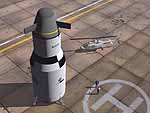
Rotary Rocket Company¿s Roton will be the first piloted fully reusable
space vehicle. Its single-stage -to-orbit (SSTO) design will be capable of
daily flights to low Earth orbit. All existing commercial launch services
now rely on one-use multi-stage expendable rockets and charge enormous
prices to put satellites into orbit, averaging $5,000 per pound. Rotary
Rocket Company has set an initial price of $1,000 per pound when the Roton
goes into service in the first quarter of 2000.
