
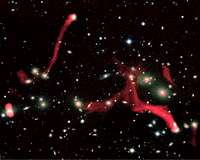
An international team of astrophysicists led by Andrea Botteon from Leiden University, the Netherlands, has shed light on one of the most intricate objects of the radio sky: the galaxy cluster Abell 2255.
Thanks to the incredible detailed images obtained with the European radio telescope LOFAR, the scientists have been able to observe details never seen before of the emission from the cluster.
The halo in Abell 2255 is not smooth, but contains numerous filaments that have not been seen previously. The result has been presented at the virtual annual meeting of the European Astronomical Society (EAS) and will be published in The Astrophysical Journal.
The observations carried out with the LOFAR radio telescope are changing the picture that astrophysicists had on galaxy clusters. Despite their name, clusters are not only composed by hundreds of galaxies spread over millions of light years that are bound together by gravity, but also contain particles moving at speeds close to the speed of light that are able to emit radiation in the radio band, when they interact with the cluster magnetic field.
These radio emissions, that extend from cluster centers for millions of light years and are produced when two clusters of galaxies collide, have been called radio halos due to their generally spherical and smooth appearance.
The halo in Abell 2255 appears to be anything but smooth, though. First author Botteon: "We discovered the existence of numerous filaments within the halo emission that have not been seen previously.
This was possible thanks to LOFAR, which has a sensitivity and angular resolution much higher than the radio telescopes that have observed galaxy clusters in the past, and also because the discovered filaments emit most of their radiation in long radio wavelengths, precisely those detected by the LOFAR antennas."
Radio halos are still enigmatic sources for astrophysicists. One of the most accepted hypotheses on their origin is that they form due to the turbulent motions generated in the cluster gas, triggered when two clusters collide. In this framework, the new observations could provide valuable insights on radio halos.
"The filaments discovered by LOFAR could form exactly as a consequence of these turbulent motions," says Gianfranco Brunetti of INAF-Bologna (Italy) and second author of the study.
"Another possibility that we are considering is that the filaments originate from the interaction between the galaxies, which move at speeds of many hundreds of km/s inside the cluster and the plasma that produces the radio emission of the halo."
"The filamentary nature of the emission shows the importance of turbulent magnetic fields, as the bands of emission are likely to follow the threads of magnetic fields," adds team member Marcus Bruggen from the University of Hamburg, Germany.
