
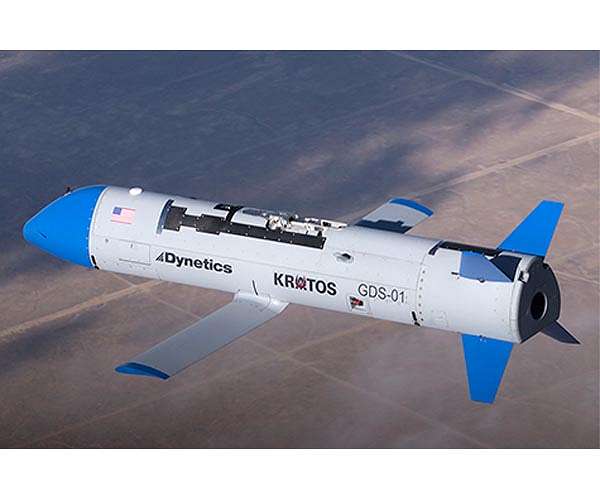
X-61A unmanned aerial vehicles flew successfully in a test but could not be retrieved by a cargo plane, the Defense Advanced Research Projects Agency said.
It was the third test of the vehicles, nicknamed Gremlins Air Vehicles. Three were launched at an undisclosed location in tests beginning in late October, DARPA said in a statement on Thursday.
While all autonomous flying positions and safety functions were achieved, the final step, retrieval by an extended arm from a C-130 plane, called a docking bullet, was not. The Gremlins, built in a $32.4 million contract begun in 2018 by Dynetics, a subsidiary of Leidos, parachuted safely to the ground.
"All of our systems looked good during the ground tests, but the flight test is where you truly find how things work," said Scott Wierzbanowski of DARPA's Tactical Technology Office. "We came within inches of connection on each attempt but, ultimately, it just wasn't close enough to engage the recovery system."
"We made great strides in learning and responding to technological challenges between each of the three test flight deployments to date," he added. "We were so close this time that I am confident that multiple airborne recoveries will be made in the next deployment."
The current DARPA tests call for launch, from a variety of aircraft, and recovery within 30 minutes.
The Gremlins are designed as recoverable, low-cost unmanned vehicles with digital flight controls, navigation systems and mission-specific technologies, to be recovered in midair after their missions. The 1,500-pound vehicles are 14 feet in length, with a wingspan of 11.5 feet.
The first flight of an X61-A occurred in 2019. While an airborne retrieval was not scheduled, the vehicle crashed when its parachute failed to open.
