
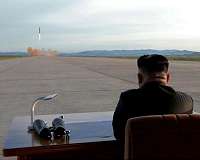
How much should you test a missile before you call it operational? That depends on who you are. The subject of North Korea's lack of any ballistic missile tests since 2017 has appeared frequently in everything from Presidential tweets to boffin white papers. Some pundits tout it as a symbol of non-aggression, and it some ways, that's true. Some missile tests are designed to serve as warning shots, signalling intent to other as states. The lack of any recent "warning shot" launches is clearly designed to soothe tensions as North Korea embarks on diplomacy.
But test launches are primarily conducted for technical reasons. Even a "warning shot" does double-duty by proving the effectiveness of the system. The lack of missile testing in recent times, and the small number of tests of certain new missiles, have prompted a focus on these technical issues for North Korea.
Recently, the US-based think tank 38 North, which studies North Korea, returned to this issue. 38 North is credible, and their reports should be taken seriously. But like any group, they are not above scrutiny. 38 North correctly states that North Korea hasn't tested their new missiles as much as most engineers would like.
The relatively meagre testing regime raises questions about the potential reliability of these missiles. Fair enough. These are strong arguments. 38 North also concedes that nobody outside of North Korea has access to the same data as the North Koreans, and the success of these tests can't be conclusively evaluated. That's also a reasonable statement. They also admit that judging the right number of test launches for a missile program is a subjective exercise for anyone.
This analyst wishes to add to the debate, with an emphasis on the subjectivity of the program. This is not the first time that North Korea has caught boffins by surprise by doing things differently. Subjectivity can apply not only to the number of tests, but the design, manufacturing and command structures for weapons systems. Given the relative lack of precise knowledge of North Korea's missile infrastructure, we cannot necessarily assume that they would copy the rest of the world in any of these respects.
North Korea conducted a large number of ballistic missile tests in 2017 before entering this quiet period. The short time interval between some of these tests (especially its July 2017 ICBM tests) was instructive. North Korea seemed happy to launch again quickly, with no need to backtrack to correct mistakes.
So a short testing regime for a specific missile can still be reassuring, especially if no problems are detected. And program engineers can also decide that they will lower the bar for their testing program. Near enough can be good enough.
The missile system may not be totally reliable, but enough missiles will reach their targets to be effective. Again, what is considered "effective" could be different to North Korea's military than to the commanders of other missile forces. It depends on the targets, strategic goals and how the missile program is integrated into the overall warfighting strategy.
Testing is also expensive. Ballistic missiles can only be flown once. You can't just land them and take off again. Each missile, especially a prototype, costs much in terms of time, money and effort to produce. A reduced testing regime saves a lot of money, especially for a nation facing severe economic sanctions.
North Korea's isolation and denial of resources must have forced its boffins to improvise and sometimes cut corners. They are expected to produce effective missiles under conditions that would be unacceptable to most Western engineers.
A close reproduction of the typical design, testing and production model used elsewhere is probably infeasible. So transposing the modus operandi of another nation onto the North Korean system is not always advisable for analysts. The subjectivity of the testing regime is just one aspect of a program that could be different in so many other ways.
