
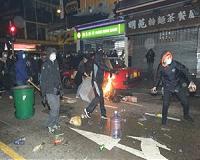
Hong Kong riot police fired tear gas and water cannon at hardcore pro-democracy protesters hurling rocks and petrol bombs on Sunday, tipping the violence-plagued city back into chaos after a brief lull in clashes.
Tens of thousands of people defied authorities to march through the city in an unsanctioned rally on Sunday, the latest expression of a popular revolt that has raged for the last 99 days.
The rally descended into violence when small groups of hardcore activists — known within the movement as "braves" — attacked the city's main government complex.
Police fired repeated volleys of tear gas and deployed water cannon trucks after Molotov cocktails and rocks were thrown over security barriers surrounding the complex, which has become a frequent flashpoint in the ongoing protests.
Local television networks broadcast footage of protesters tearing down and burning a huge banner celebrating the upcoming 70th anniversary of the founding of communist China — as well as torching a Chinese flag.
As evening set in, protesters retreated, chased by riot officers and water cannon firing blue-dyed water.
Hong Kong's summer of rage was sparked by a now-abandoned plan to allow extraditions to the authoritarian mainland, a move that prompted millions to hit the streets.
As Beijing and local city leaders doubled down, the protests rapidly snowballed into a much wider anti-government movement.
On Sunday, some demonstrators built barricades, set fires and vandalised subway stations, but the crowds avoided further direct clashes and largely ran away when ranks of police officers got close.
– Street brawls –
Throughout the evening, multiple brawls broke out between political opponents, including in the districts of Fortress Hill and North Point, the latter a bastion of pro-Beijing sentiment.
Witnesses said a group of Beijing supporters armed with poles and improvised weapons attacked people in Fortress Hill, but were then set upon by a larger crowd of anti-government protesters.
Two men were treated by paramedics for bloody wounds and rushed away in ambulances.
"They attacked us today and yesterday, so we chased and attacked them," a democracy protester, who gave his name as John, told AFP.
Pro-democracy supporters also attacked at least two men in Causeway Bay and further fights took place in North Point, AFP reporters on scene saw.
The clashes ended a relative lull in recent days in the intensity of skirmishes between police and protesters.
The once-stable international hub has been convulsed by weeks of huge, sometimes violent rallies calling for greater democratic freedoms and police accountability.
The movement is the biggest challenge to China's rule since the city was handed back by Britain in 1997 and shows no sign of ending.
Under a deal signed with Britain ahead of the handover, Hong Kong is allowed to keep its unique freedoms for 50 years.
But democracy activists accuse Beijing of reneging on those promises by tightening political control over the semi-autonomous territory and refusing calls for universal suffrage.
– Protest outside UK consulate –
Earlier on Sunday, protesters rallied outside Britain's consulate in Hong Kong, demanding London do more to protect its former colonial subjects and ramp up pressure on Beijing over sliding freedoms.
Hundreds of demonstrators sang "God Save the Queen" and "Rule Britannia" outside the consulate, waving the Union Jack as well as Hong Kong's colonial-era flags.
Many protesters said Britain was not doing enough to confront Beijing over its tightening grip on the semi-autonomous city.
They also called for Hong Kongers who want to leave the city to be granted citizenship in Britain or other Commonwealth nations.
"At least with the full citizenship, they can protect Hong Kong people from the Chinese government," protester Anthony Chau told AFP.
Earlier this week, some 130 UK lawmakers signed a joint letter calling for Britain and Commonwealth countries to come up with an "insurance policy" for Hong Kongers to resettle overseas should they wish to.
– Leaderless movement –
The pro-democracy movement has vowed to continue until key demands are met, including an inquiry into the police, an amnesty for those arrested, and universal suffrage.
City leader Carrie Lam and Beijing have shown little appetite for making concessions.
Lam has said she is willing to hold a dialogue, but protesters must abandon violence first.
But the movement is leaderless — a response to authorities prosecuting high-profile democracy figures from previous protests — making it difficult for Lam to know who to negotiate with.
Online message boards have filled with plans for new rallies and strikes in the coming weeks, fuelled by two key anniversaries.
September 28 is the fifth anniversary of the start of the failed pro-democracy Umbrella Movement protests, while October 1 is the 70th anniversary of the founding of the People's Republic of China.
Protesters call on UK to protect Hong Kongers from China
Hong Kong (AFP) Sept 15, 2019 –
Pro-democracy protesters rallied outside Britain's consulate in Hong Kong on Sunday, demanding London do more to protect its former colonial subjects and ramp up pressure on Beijing over sliding freedoms.
Hundreds of demonstrators sang "God Save the Queen" and "Rule Britannia" outside the consulate, waving the Union Jack as well as Hong Kong's colonial-era flags.
The protest came as another large rally made its way through the city streets on Sunday afternoon in defiance of a ban by police, who warned the gathering was illegal.
"We have a right to go to protests, to the streets, and we have to voice our demands to the government," a secondary school student at the rally who gave his name as Alvin, told AFP.
The once-stable international hub has been convulsed by weeks of huge, sometimes violent rallies calling for greater democratic freedoms and police accountability.
The movement is the biggest challenge to China's rule since the city was handed back by Britain in 1997 and shows no sign of ending, with local leaders and Beijing taking a hard line.
Under a deal signed with Britain ahead of the city's 1997 handover to China, Hong Kong is allowed to keep its unique freedoms for 50 years.
Democracy activists accuse Beijing of reneging on those promises by tightening political control over the semi-autonomous territory and refusing calls for universal suffrage.
Many of the protest signs accused Britain of not doing enough to confront Beijing over its tightening grip on the semi-autonomous Chinese city.
"Sino-British Joint Declaration is VOID," one read, referencing the 1984 agreement that paved the way for the city's handover, a deal that Hong Kongers were given no say over.
"So far I'm quite disappointed by the fact that the UK hasn't done anything to support us," protester Alex Leung, a recent graduate, told AFP.
Many called for Hong Kongers who want to leave the city to be granted citizenship in Britain or other Commonwealth nations.
Some Hong Kongers were given British National Overseas (BNO) passports before the handover, a document that allows holders easy travel to the UK but grants no working or residency rights.
"At least with the full citizenship they can protect Hong Kong people from the Chinese government," protester Anthony Chau, who holds a BNO passport, told AFP.
Earlier this week some 130 UK lawmakers signed a joint letter calling for Britain and Commonwealth countries to come up with an "insurance policy" for Hong Kongers to resettle overseas should they wish to.
– Britain treads carefully' –
Hong Kong has been battered by nearly 100 days of protests, sparked by a now-abandoned plan to allow extraditions to the mainland.
China has portrayed the protests as foreign-funded, singling out Britain and the United States for criticism, although it has presented little evidence beyond supportive statements from some foreign politicians.
It has insisted Hong Kong — an international finance hub with a significant foreign population — is an entirely internal matter.
Britain has walked a careful path on the protests, keen to keep Beijing onside as a valuable trade partner, especially given the uncertainty thrown up by its imminent departure from the European Union.
But it has also expressed concerns about the direction Hong Kong has headed and says it has a duty to ensure Beijing upholds the deal it struck before the handover.
"The Joint Declaration is a legally binding treaty between the UK and China that remains as valid today as it was when it was signed and ratified over 30 years ago," a British Foreign Office spokeswoman said in June.
Democracy advocates have ramped up appeals to the international community in recent weeks, with prominent activists travelling overseas and crowd-funding used to print adverts in global newspapers.
Joshua Wong, a well-known activist, is currently in the United States and met Germany's foreign minister earlier this week in Berlin — a trip that has infuriated Beijing.
Sunday's protest outside the UK mission was significantly smaller than a huge march the week before to the United States consulate which saw tens of thousands turn out.
The pro-democracy movement has vowed to continue until key demands are met, including an inquiry into the police, an amnesty for those arrested and universal suffrage.
There are plans for further protests in the coming weeks, culminating on 1 October when leaders in Beijing are planning huge celebrations to mark the 70th anniversary of the People's Republic of China.
