
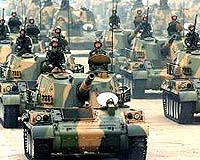
Tanks rumbled through Beijing early Thursday as China geared up to mark 60 years of communist rule with a choreographed show of mass patriotism glorifying the nation's revival as a global power.
Dozens of tanks thundered down locked-down avenues toward positions near Tiananmen Square ahead of a massive military parade and spectacular pageant depicting how the Communist Party has led China from chaos to prosperity.
President Hu Jintao was to kick off the festivities at about 10:00 am (0200 GMT) with a speech at the historic square to an invitation-only audience of spectators and foreign dignitaries, with security air-tight across the city.
China typically holds grand celebrations every 10 years to commemorate revolutionary leader Mao Zedong's proclamation of the founding of the People's Republic of China on October 1, 1949.
But this year's festivities promise to top those staged in the past, with at least 100,000 people taking part in an extravaganza that officials say will outdo even last year's lavish opening ceremony for the Beijing Olympics.
The authorities want to send a clear message: that China has re-emerged as an undeniable force in the world.
Vice Foreign Minister Zhang Zhijun told journalists this week that the event would showcase "a China which has strong confidence in its future".
Underlining this confidence, Premier Wen Jiabao predicted further Chinese greatness in a speech to a 60th anniversary reception on the eve of the gala.
"In another 40 years, the 100th anniversary of our nation's founding will come. At that time, a prosperous, powerful, democratic, civilised, harmonious and advanced socialist nation will tower over the East," he said Wednesday.
China will add teeth to those projections with a parade expected to feature nuclear missiles and other high-tech, Chinese-developed weaponry meant to convey the message that a nation once bullied by foreign powers is a pushover no more.
But the apparent insecurity of the ruling Communists has been just as clearly on display — authorities have imposed draconian security in a seeming bid to prevent an array of perceived threats from spoiling the party.
These include seething tensions in ethnic minority regions like Xinjiang and Tibet, and widespread social discontent over a widening wealth gap, official corruption and horrific environmental degradation.
As a result, Beijing's 17 million citizens will be relegated to watching the festivities in their hometown on television like the rest of the nation.
Police have for weeks been checking traffic entering the capital, residents along the parade route were ordered not to open their windows during the event, and even the city's airport will shut for the parade's three-hour duration.
Beggars and the homeless have been cleared out and knife sales temporarily banned in some stores after two recent stabbings near Tiananmen Square, while even the flying of pigeons and kites has been ruled out.
The Mao-led 1949 communist takeover ended years of foreign domination and war, while three decades of economic reforms initiated by late leader Deng Xiaoping enriched China and propelled it back into the ranks of world powers.
China's state-controlled media has for months unleashed a continuous barrage of content extolling the nation's Communist Party-led re-emergence that will culminate with Thursday's patriotic gala.
Share This Article With Planet Earth
