
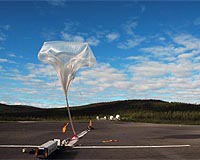
At 7:07 local time on Saturday (28 June) a large balloon-borne experiment called MEAP(1) took off from SSC:s launch facility Esrange Space Center in northern Sweden. The aim of the flight is to perform tests of new techniques connected to the flight itself and to the new mass spectrometer planned to be used in the future on space flights to other planets.
The gondola was lifted by a large balloon of 334.000 m3 (100 m in diameter) and reached the predicted altitude of 36 km within 2 hours. After 5-6 days the payload will be cut off from the balloon and descend under a parachute to land in the northern parts of Canada or Alaska. The payload will be recovered by helicopter after landing.
Future circumpolar flights
The technical aim of this flight is to extend the range of SSC balloon flights from Esrange Space Center to include circumpolar flights around the North Pole during the summertime. Circumpolar flights have been performed many times before during the winter, when the nights are dark and sensitive optical measurements need to be protected from the sunlight.
In other scientific missions, where the instruments are not so sensitive to light, the midnight sun helps charge the batteries on board during long duration balloon flights.
"This successful launch is an important step for SSC to prepare for our next big challenge within ballooning", says Dr. Olle Norberg, Head of Esrange Space Center.
"We are planning to offer the scientific community long duration flights around the North Pole during both summer and winter, in order to meet the scientists' desire to fly experiments all year around. We are in an intensive phase of developing a range of new technical systems to make this happen. We are also working on getting a permanent permission to fly over Russia".
The technique on board
Flying a balloon to the other side of the Earth, out of sight of the launch location, involves a lot of sophisticated technology.
For this flight some new systems will be tested: solar panels with a power distribution system to the balloon platform and the experiment on board, remote communication via the Iridium satellite system, heating/cooling technology, telemetry/command systems and GPS positioning systems.
(1)MEAP – The science on board
MEAP (Mars Environment Analogue Platform) is a scientific project performed in collaboration by the University of Bern in Switzerland and the Swedish Institute of Space Physics (IRF) in Kiruna, Sweden. It is an exciting project that will play an important role in the development of similar instruments for planetary and atmospheric research, particularly on Mars but even on Venus.
As the atmospheric conditions at 30-40 km altitude are remarkably similar to those on the surface of Mars, the balloon is an ideal test bed for instrumentation destined for Mars: MEAP carries the high resolution neutral gas mass spectrometer P-BACE (Polar Balloon Atmospheric Composition Experiment), for in situ measurement of atmospheric composition.
P-BACE has a mass range that significantly exceeds that of previous instruments, so the present investigation has the potential for interesting research in this chemically highly complex and dynamic region of the atmosphere.
