
Unusual seismic activity in a volcanic zone near Iceland's capital Reykjavik that has been dormant for almost 800 years has left experts stumped and searching for clues as to whether an eruption is imminent.
The eerie cone of Mount Keilir rises up over the lunar-like landscape, just 25 kilometres (15 miles) from Reykjavik, looming over the area now being closely monitored by vulcanologists for the first signs of an eruption.
Iceland has been on high alert since last week after a series of small earthquakes and tremor pulses related to increased magma flow in the Krysuvik volcanic system, with the chances of an eruption seen as pretty likely last week.
But since then, with no eruption forthcoming, doubts have arisen about whether there will be one after all.
The Civil Protection Agency on Monday said "we must continue to assume there is a possibility of an eruption."
"This always has to be taken seriously because it can change very fast," Thorbjorg Agustsdottir, a seismologist at Iceland GeoSurvey, told AFP.
The latest data indicate the magma is just about a kilometre from the Earth's surface.
"That's very shallow. This magma is most likely coming from a source of at least eight to 10 kilometres, it could even be 20-plus kilometres," said University of Iceland vulcanologist Thorvaldur Thordarson, though magma like this does not always break through the Earth's surface.
According to experts, any eruption would most likely occur in a fissure located between Mount Keilir and Mount Fagradalsfjall, in an uninhabited zone that poses no risk to human life or material damage.
– New cycle of eruptions? –
Krysuvik is a so-called volcanic system, with no central volcano. The system last erupted in the 12th century, while the last eruption on the Reykjanes peninsula was in 1240.
Small signs of a reawakening on the peninsula first appeared more than a year ago, but it was a large 5.7-magnitude earthquake on February 24 that signalled a major seismic event could be about to happen.
Since then, the Icelandic Meteorological Office (IMO) has registered more than 34,000 tremors on the peninsula, a number unseen since digital monitoring began in 1991.
After a two-day lull, seismic activity intensified again overnight Tuesday to Wednesday.
"As we have learned, this may be going through phases, but that indeed is a very high activity level for this year," said Sara Barsotti, the IMO's volcanic hazards coordinator.
Iceland is Europe's biggest and most active volcanic region, and is studied extensively by experts who have a vast monitoring network on the North Atlantic island.
But the volcanic zone on the Reykjanes peninsula remains nonetheless an enigma.
"We don't know how the magma systems on the Reykjanes peninsula prepare for an eruption. What kind of unrest signals are associated with this? How long does it take? We don't know. Because we've never been able to measure it," said Thordarson.
But one thing is certain: in the event of an eruption, it would be a limited burst of lava, and not much ash.
In other words, nothing like the 2010 eruption of Iceland's Eyjafjallajokull volcano, whose massive plumes of ash disrupted air traffic for weeks in Europe and left millions of travellers stranded.
"The eruptions on this volcanic zone, they are generally quite peaceful. These are lava effusions and not really terribly big for most of them," said Pall Einarsson, a geophysicist at the University of Iceland.
Geological studies show that the tiny peninsula is home to five volcanic systems which all appear to show signs of life about every 800 years.
The most recent volcanic activity in the region lasted for three centuries, with several eruptions lasting more than a decade.
"We may be heading towards a new erupting period on the Reykjanes peninsula," suggested Thordarson.
This would not be the first time a dormant volcanic zone reawakens in Iceland.
One early morning in 1973, fountains of lava surprised inhabitants of the island of Heimaey, in the Westman Islands, erupting from a fissure just 150 metres (yards) from the town centre, in that volcano's first eruption in 5,000 years.
More recently, experts warned in June 2020 that the Grimsvotn volcano under the Vatnajokull glacier — Iceland's most active volcano — was getting ready to erupt, but so far that has not happened.
Iceland's main volcanic eruptions
Reykjavik (AFP) March 10, 2021 –
Known as the land of fire and ice, Iceland is Europe's biggest and most active volcanic region, home to a third of the lava that has flowed on Earth since the Middle Ages, according to Visit Iceland.
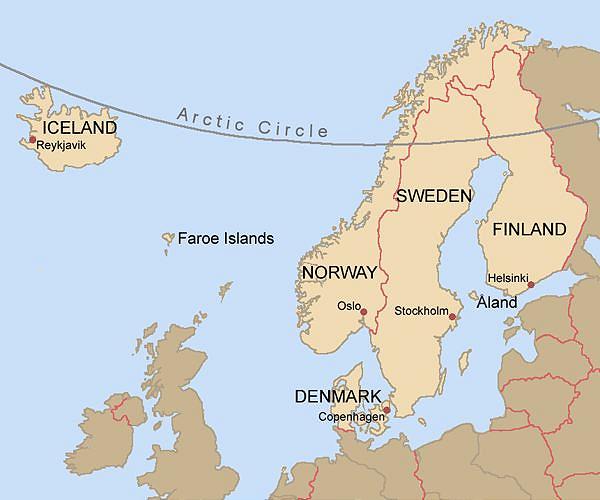
The vast North Atlantic island borders the Arctic Circle where it straddles the Mid-Atlantic Ridge, a crack on the ocean floor separating the Eurasian and North American tectonic plates.
The shifting of these plates is in part responsible for Iceland's intense volcanic activity.
Thirty-two volcanic systems are currently considered active in the country.
Here are the main eruptions in Iceland's history:
2014-2015
The awakening of Bardarbunga, a volcano located under the Vatnajokull glacier — Europe's largest ice cap — in the heart of southern Iceland's uninhabited highlands, is the most recent eruption to date.
The volcano erupted for five months, both under the ice and breaching the surface in a fissure at the Holuhraun lava field, creating Iceland's biggest basalt lava flow in more than 230 years but causing no injuries or damages.
2011
The Grimsvotn volcano, also located under the Vatnajokull glacier, is Iceland's most active volcano. Its latest eruption was in May 2011, its ninth since 1902. Over one week, it spouted a cloud of ash 25 kilometers (15 miles) into the sky, causing the cancellation of more than 900 flights, primarily in the UK, Scandinavia and Germany.
2010
In April 2010, enormous plumes of ash billowed into the sky for several weeks during the eruption of the Eyjafjallajokull volcano, causing the biggest air traffic disruption in peacetime until the Covid-19 pandemic. Some 100,000 flights were cancelled, leaving more than 10 million travellers stranded.
1973
In one of the most dramatic eruptions in the country's recent history, the island of Heimaey in the Westman Islands awoke one January morning to an eruption in a fissure just 150 metres (yards) from the town centre. The eruption of the Eldfell volcano occurred not only in a populated area — one of the country's then most important fishing zones — but it also surprised locals at dawn. A third of homes in the area were destroyed and the 5,300 residents were evacuated. One person died.
1918
Considered one of Iceland's most dangerous volcanoes, Katla's last eruption added five kilometres of land mass to the country's southern coast. Located under the Myrdalsjokull glacier, when Katla erupts it ejects large quantities of tephra, or solidified magma rock fragments which are disseminated in the air and carried by the powerful glacier flooding caused by melting ice. Averaging two eruptions per century, Katla has not erupted violently for more than 100 years and experts say it is overdue.
1875
Virtually unknown at the time, Askja, Iceland's second-biggest volcano system, erupted in three distinct phases. Two of the three ash clouds rose more than 20 kilometres (12 miles) into the sky. The toxic fallout across Iceland, which in some places reached a thickness of 20 centimetres (eight inches), killed livestock, contaminated the soil and sparked a wave of emigration to North America. Isolated in a plateau and far from civilisation, Askja is today a popular tourist attraction and its lava fields were used to train astronauts for the 1965 and 1967 Apollo missions.
1783
The eruption of the Laki volcanic fissure in the south of the island is considered by some experts to be the most devastating in Iceland's history, causing its biggest environmental and socio-economic catastrophe: 50 to 80 percent of Iceland's livestock was killed, leading to a famine that left a quarter of Iceland's population dead.
The volume of lava, nearly 15 cubic kilometres (3.6 cubic miles), is the second-biggest recorded on Earth in the past millennium.
The meteorological impact of Laki's eruptions had repercussions for several years in the Northern Hemisphere, causing a drop in global temperatures and crop failures in Europe as millions of tonnes of sulfur dioxide were released. Some experts have suggested that the consequences of the eruption may have played a part in triggering the French Revolution, though the issue is still a matter of debate.
The volcano's 130 still-smoking craters were placed on UNESCO's World Heritage list in 2019, along with the entire Vatnajokull national park to which it belongs.
934
The eruption of Eldgja — which means "canyon of fire" in Icelandic — is the biggest basalt lava eruption the world has ever seen. Part of the same volcanic system as the mighty Katla volcano, the Eldgja fissure is 75 kilometres long, stretching to the western edge of Vatnajokull. The eruption led to two large lava fields covering 780 square kilometres (301 square miles).
