
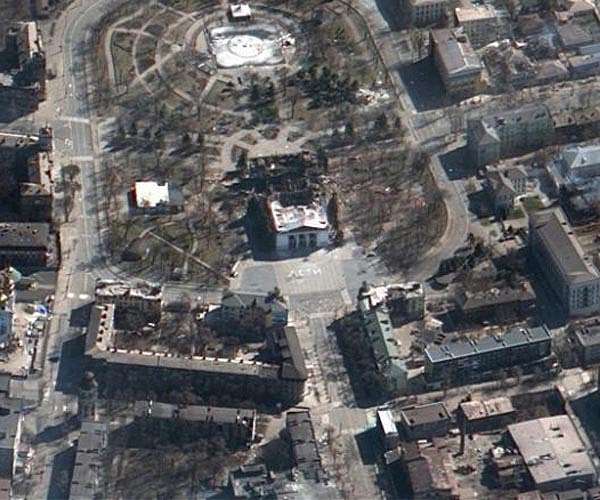
Two women that survived the Russian airstrike on a theatre sheltering civilians in Ukraine's besieged city of Mariupol earlier this month told AFP about the "horror" they endured.
Viktoria Dubovytskaya was inside the Mariupol drama theatre when it was hit on March 16. Maria Kutnyakova — who left the theatre to get water the day of the shelling — witnessed the strike from outside, while her mother and sister were still in the building.
The two residents of the besieged port city are now refugees on the other side of Ukraine, in the western city of Lviv, where they spoke to AFP about the minutes before and after the bombing, which Kyiv blames on Russia.
Mariupol has suffered near total destruction since Moscow's invasion of Ukraine.
An estimated 160,000 people remain trapped in the southeastern city, with many left without food in the cold.
– Theatre refuge –
Looking to escape the shelling and bombing, hunger and cold, Viktoria Dubovytskaya had taken refuge in the theatre on March 5 with her two young children.
She thought she could then find an evacuation convoy to join with her two-year-old daughter Anastasia and six-year-old son Artyom.
The day the drama theatre was shelled began calmly.
The two children were playing near their mother when the bomb crashed into the building.
Dubovytskaya was thrown against the wall and injured her face. She immediately heard her son scream, but not her daughter.
"It was the most frightening moment, when you think that she's not there anymore," the 24-year-old recalled, two weeks on, as she held her daughter in a shelter in Lviv.
"You hope that maybe she is without arms or legs, but at least alive."
According to satellite images of the theatre and witness testimony collected by AFP, the word "deti" ("children" in Russian) had been painted in large white letters in front and behind the theatre.
Authorities said 1,000 people were inside the theatre at the time of the strike, mostly women and children.
It is still unknown how many people were killed in the strike.
Mariupol city hall put the figure at 300, citing witnesses.
"Everyone knew that there were children in the theatre, even my husband whom I could not contact because there was no reception," said Dubovytskaya.
Her husband was working in neighbouring Poland when Moscow launched its invasion of Ukraine. He came to pick them up in Mariupol after the strike.
"I was going there and I did not know if they were alive or not, but I had hope," Viktoria's husband Dmitry told AFP.
– 'Miraculously' survived –
Like Dubovytskaya, Maria Kutnyakova, a communications manager at a start-up in Mariupol, also hoped to join a humanitarian convoy at the drama theatre with her mother and sister.
The family had run out of food and water after a strike on March 10 took out most of their apartment's kitchen and bathroom, as well as killing a neighbour.
The theatre was meant to be a starting point for evacuations via an official humanitarian convoy.
It also became a rallying point for individuals hoping to try their luck in their own convoys, according to the two Mariupol residents.
Russia alleges that the theatre had housed soldiers from the nationalist Azov battalion.
But the two witnesses told AFP that no soldier was in the theatre at the time of the airstrike.
"The soldiers came once a day to announce if there would be a humanitarian convoy and then left immediately," said Viktoria Dubovytskaya.
She specified that only once, four Ukrainian soldiers spent the night there, after a nearby bombing.
On March 16, Maria, her sister and her mother moved to the third floor of the theatre, due to a lack of space on the lower floors and in the basement.
When she went to get water from her uncle in the next building, she heard a plane flying and then the bomb being dropped.
"When I came closer, I saw that the theatre did not have a roof anymore. The debris and wounded were there," she said, still in shock, now speaking from a theatre in Lviv where she is taking refuge after a three-day journey out of Mariupol.
When she went inside the bombed theatre, she heard desperate calls of first names in the rubble, of people looking for their loved ones.
To find her mother and sister, the 30-year-old screamed out their last name.
They had "miraculously" survived.
– 'Common grave' –
Both the women got stuck in the theatre after the strike.
"Outside, the Russians continued to shoot and inside, the building was burning," said Kutnyakova.
She then ran to another improvised shelter and the local philharmonic nearby. It was also bombed the same evening.
Homeless and without shelter, the family decided to embark on a risky journey "to finally be in a place where the ceiling won't fall on our heads."
It was on the way out of Mariupol that Dubovitskaya saw the extent of the city's destruction.
She said bodies lay in the rubble, sometimes small wooden crosses planted in the ground.
"When people find their loved ones, they just bury them wherever then can. Sometimes where roses used to bloom," she said. "The city is now a common grave for everyone."
Ukrainian Paralympian escapes Russian-held city to safety
Zaporizhzhia, Ukraine (AFP) April 1, 2022 –
With her wheelchair perched on her lap, Ukrainian world champion powerlifter Raisa Toporkova escaped with friends from the occupied city of Enerhodar where Russian forces were shelling Europe's largest nuclear power facility.
They had lost their homes, but not their sense of humour.
"If the Russians came after us, at least we have our sticks to defend ourselves," joked Yevhenii Razikov, who has cerebral palsy and shared the perilous journey to safety.
Crammed into a car with several others with special needs, Toporkova spent 12 hours negotiating a series of checkpoints to flee the city in southern Ukraine.
"It would be impossible to get out of the car if something happened," Toporkova, who was fifth at last year year's Tokyo Paralympics, told AFP in the regional capital Zaporizhzhia.
"My wheelchair was on me and two of the others need a stick to walk."
More than 10 million Ukrainians have fled their homes since Russia invaded on February 24, but for people with disabilities, the often long and difficult journey can be an almost impossible undertaking.
Russian troops shelled Enerhodar, the site of Europe's largest nuclear power plant, in early March, causing a fire, which was eventually put out.
The attack led to international outrage with memories still fresh of the 1986 explosion at Ukraine's Chernobyl nuclear reactor, the world's worst nuclear accident.
Toporkova, who has been in a wheelchair for most of her life due to a musculoskeletal growth disorder, said the situation was deteriorating fast in Enerhodar after a month under Russian control.
She was barely able to go out and her first-floor home had no basement to take shelter from the many explosions.
Food supplies were running low and prices had risen by as much as four times. Pharmacies were out of vital prescription medicines.
Another uptick in violence at the nuclear plant could mean a lethal radiation leak.
Worried that the opportunity to leave could close, Toporkova fled on Monday with husband Anton Vavryshchuk, 37, who is also physically disabled.
They were joined by their friends, Razikov and his wife, who did not want to be identified. Both have cerebral palsy.
– Shelling constantly –
"My wheelchair was on our lap and there was shelling constantly. We were scared we would be killed there and the explosions got even louder when we reached the checkpoint," Toporkova said.
After their minibus broke down on the outskirts of the city they were worried their chance was gone, but a Red Cross volunteer managed to transfer them to a car.
Yet at one checkpoint, they were held for seven hours.
It was a long and painful wait for the group, whose physical difficulties were exacerbated by long periods of sitting in a car.
There are more than seven million people aged 60 or older in Ukraine and 2.7 million people with disabilities, according to the European Disability Forum.
Advocacy groups have warned that many would not be able to escape or seek shelter due to lack of mobility.
Out of a column of more than 100 cars, the group said they were eventually one of only two vehicles that were allowed to pass. The journey took 12 hours instead of the usual two because of difficulties at checkpoints.
"There were three possible outcomes: one is that we got hit by the shelling, another is we got stuck and then who could possibly save us. The third is that we got out, and thankfully that's what happened," said Razikov.
– Two-time world champion –
Toporkova started powerlifting 19 years ago and is a two-time world champion.
She has not been able to train since the war began in late February and gyms closed and she also faced losing her job and means to earn a living if she stayed. She used to do three two-hour sessions a week.
"If I don't train for one week, it's OK, but two weeks is terrible," she said. "Let's say I could lift 100 kilograms before, after that time I would only be able to lift 80kg."
"I'm losing results if I'm not training and I won't get invited to international competitions anymore."
Now she is heading to Lviv in western Ukraine and hopes to be able to return to the gym.
"I cannot wait to start training again."
