
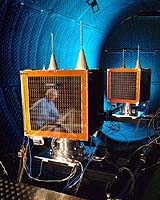
SSTL are preparing for the launch of three more spacecraft in the international Disaster Monitoring Constellation – the first cluster of satellites dedicated to monitoring disasters from space.
The three spacecraft, each with a mass of approximately 100kg, have arrived at the Plesetsk Cosmodrome in northern Russia and SSTL engineers are now on-site preparing for a 26 September launch onboard a KOSMOS rocket.
BILSAT for Turkish customer Tubitak-ODTU Bilten, NigeriaSat-1 for Nigerian customer, and National Space Research & Development Agency UK-DMC funded by the UK Government / BNSC
The launch this month will complete the first phase of the constellation, kicked-off last November with the launch of AlSAT-1 for SSTL's Algerian customer, Centre National des Techniques Spatiales and the Algerian Space Agency.
The DMC will provide daily imaging at 32m resolution and up to a 600km swath across the world, enabling rapid repeat imaging for regular updates of disaster situations – something not achievable by any other commercial satellite currently in orbit.
AlSAT-1 is fully operational in orbit and demonstrating the DMC spacecraft's remarkable capability by returning outstanding Earth observation imagery. The International Charter has recently used AlSAT-1 imagery to observe the Monserrat volcano eruption.
The DMC is a novel international partnership, brought together by SSTL and supported by the British National Space Centre (BNSC) MicroSatellite Applications in Collaboration (MOSAIC) programme, which has given financial assistance to small satellite programmes.
An enhanced DMC satellite for China, currently under construction at SSTL at the Surrey Space Centre, will join the DMC when it is launched in early 2005.
The upcoming launch is scheduled for 06:09 GMT on Friday, 26 September 2003 with a live satellite link across Europe via Eutelsat W2. Satellite co-ordinates for the transmission will be available, together with the running order, 48 hours before the event on SSTL's website.
