
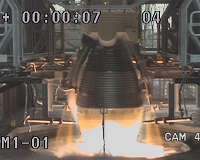
The Vulcain 2.1 engine, developed by ArianeGroup to power the main stage of the Ariane 6 launcher, for which the maiden flight is scheduled for 2020, has just been successfully tested by the DLR (German Aerospace Center) on the P5 test facility at its site in Lampoldshausen, Germany on behalf of ArianeGroup.
This is a version of the Ariane 5 Vulcain 2 engine especially adapted for the Ariane 6 main stage, to simplify production and to lower costs. To reach these objectives the engine integrates technologies such as a gas generator built using 3D printing, a simplified divergent nozzle, and an oxygen heater for tank pressurization.
These adaptations contribute to achieving the cost targets set for the Ariane 6 launcher, while retaining the efficiency and reliability demonstrated on Ariane 5.
The tests carried out at Lampoldshausen will allow the new engine to be tested throughout its flight envelope (thrust, mixing ratio, propellant supply conditions).
In parallel, the Ariane 6 upper stage Vinci engine qualification program is continuing on schedule, with more than 130 test firings performed on the two test beds in France and Germany (the P4.1 at the DLR's Lampoldshausen site and the PF52 at the ArianeGroup test site in Vernon, France), including several demonstrations of the multiple ignition capability required by Ariane customers for their missions on Ariane 6.
Design authority and industrial lead contractor for the development and operation of the Ariane 6 launcher on behalf of the European Space Agency (ESA), ArianeGroup coordinates an industrial network of more than 600 companies in 13[1] European countries, including more than 350 Small and Medium Enterprises (SMEs).
Rocket Lab successfully sends rocket into orbit
Aerospace company Rocket Lab said Sunday it had successfully fired a rocket into orbit for the first time from its New Zealand launch base.
"Electron is orbital. Successful payload deployment," the company tweeted.
The Electron rocket, named "Still Testing", took off from Mahia, on the east coast of the North Island, at 2.45pm (0145 GMT) on Sunday and reached orbit eight minutes late … read more
