
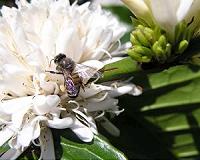
Scientists at Ohio State University found honey bees living in the outer suburbs — where residential development transitions into agricultural land — tend to forage on farms, not in urban gardens.
Researchers tracked the feeding habits of honey bees from colonies in an apiary located in a suburban cemetery in central Ohio.
The study, conducted in 2014, lasted from late summer to early fall. The bees consistently opted for the blooms found on farmland. At one point, 96 percent of all pollen being returned to the hives was being sourced from flowers on farmland.
"Honey bees didn't seem to care that much what the floral diversity was. What they wanted was large patches of their favorite stuff," Douglas Sponsler said in a news release.
Sponsler, now working at Penn State University, lead the study as a graduate student in entomology at Ohio State.
Sponsler and his colleagues were able to track foraging behavior by translating the dance-like gyrations displayed by bees as they returned to the hive. The dance movements reveal which way a bee came from and how far the bee traveled.
"These things can be pretty easily decoded by the human observer, thankfully," Sponsler explained. "You can map the locations that are being referred to in the dance."
Researchers confirmed their interpretations of the bee dances through analysis of the pollen grains themselves.
The findings — detailed in the Journal of Urban Ecology — are a reminder that, even if not ideal, farmland is preferable to more degraded urban landscapes.
"There's this popular perception that urban places are better for bees because of the diversity of plants," Sponsler said. "This is showing that, at least in Ohio, the agricultural areas are actually superior and that's despite the pesticide use that's out there."
Researchers say more can be done to make both farms and urban settings more inviting to honey bees.
"There's no reason why our urban landscapes cannot be full of flowers," Sponsler said. "It's just that we've inherited a certain preference toward things that look like golf courses rather than things that look like prairies."
This small molecule could have a big future in global food security
Researchers at the University of Arizona have found a promising way to prevent the loss of millions of tons of crops to a fungus each year, offering the potential to dramatically improve food security, especially in developing countries. The team's approach uses transgenic corn plants that produce small RNA molecules that prevent fungi from producing aflatoxin, highly toxic substances that can r … read more
