
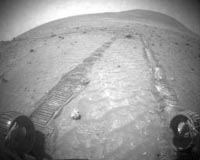
Spirit remains stationary on the west side of Home Plate. Work continues on developing the ground testing to assist the rover in extracting itself from the embedding in this location, called "Troy".
The rover has been busy with an ambitious observation campaign employing both remote sensing and in-situ (contact) science with the robotic arm (instrument deployment device, IDD). The soil, disturbed by the rover embedding, reveals unconsolidated, light-toned material.
Analysis indicates this material consists of differing amounts of ferric sulfate, calcium sulfate, silica and other constituents.
On Sol 1927 (June 4, 2009), the IDD used the microscopic imager (MI) to collect a stack of stereo images, then placed the alpha particle X-ray spectrometer (APXS) for an overnight integration.
On the next sol, the APXS was moved to a different surface target for a second integration. On Sol 1929 (June 6, 2009), another set of MI images was collected and the Mossbauer (MB) spectrometer was placed for a multi-sol integration.
On Sol 1933 (June 10, 2009), a full-rotation test was performed on the left-middle wheel to explore a stall event from Sol 1899 (May 6, 2009). The test successfully rotated the wheel one full rotation backwards and more than one full rotation forward past the point of the original stall. The wheel moved freely with no re-occurrence of a stall.
Preparation for ground testing of embedding extraction techniques continues. A soil simulant has been established by way of a series of "shoebox" (single wheel) tests of candidate materials with the surface system testbed (SSTB) rover in the sandbox at JPL. A test form to contain rover-scale quantities of soil simulant is under construction.
As of Sol 1932 (June 9, 2009), Spirit's solar array energy production is at 828 watt-hours, with atmospheric opacity (tau) of 0.502 and a dust factor of 0.749. Total odometry remains at 7,729.93 meters (4.80 miles).
Share This Article With Planet Earth
