
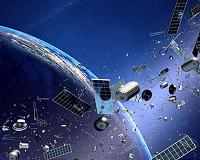
Recently, when President-elect Donald Trump was asked about his plans for NASA he reportedly said "space is terrific, but we've got to fix our potholes too." Well, this may be a revelation, but space and the space program have potholes. These are not simple terrestrial potholes. They are potentially big showstoppers, the kind that can really mess up our economy and national security. Space potholes are like highway potholes, but turned inside out.
Near-earth space is quickly getting filled up with these inverted obstructions. We called them orbiting debris objects, i.e., objects that are in orbit around the Earth as the result of space initiatives that no longer serve any function.
Examples of such debris include expired spacecraft, upper stages of launch vehicles, debris released during spacecraft separation from its launch vehicle or during mission operations, debris created as a result of (spacecraft or upper stage) explosions or collisions, solid rocket motor effluents, paint flecks and thermal blankets. Most of the orbital debris is concentrated in what is considered low-earth orbits.
The United States Space Surveillance Network estimates that there are more than 500,000 pieces of debris larger than 1 cm orbiting Earth today, including over 22,000 pieces larger than 10 centimeters that are actively tracked. This ignores the millions of untrackable smaller bits that are also up there.
Stewardship of the near-earth environment has been largely ignored by former administrations. That neglect may soon result in a serious loss of satellite services for all technologically advanced countries.
Orbital clogging due to debris buildup seems far-fetched, but in recent years the debris density in orbits between the altitudes of 600 km and 1200 km has reached a level of serious concern to satellite operators who have expensive spacecraft flying in debris-laden orbits. Over the next few years another 11,500 satellites may be added to the current population of active spacecraft in low orbits.
This will almost certainly exacerbate the debris threat to the point that some fraction of debris objects will have to be continuously removed to preserve safety for satellite services. Otherwise, the LEO zone will become clogged with debris, preventing the operation or transit of spacecraft.
Cost-effective or viable approaches to the removal of low-earth-orbital debris have been elusive. NASA and other affected agencies have ignored pursuing a solution. Yes, many have studied the problems and science of debris buildup, but solutions for removal have not been prominent in government planning.
Once these orbits get clogged, most spaceflight activities could be prohibited for hundreds of years. Such a condition would be catastrophic for all those services that depend on satellites. Technologically, we could find ourselves back in the 1960s. So, while we are fixing terrestrial potholes, it might be wise to fix the extra-terrestrial ones as well.
