
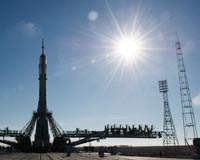
A pair of U.S. astronauts and one Russian cosmonaut are just two days away from launching on a 50-hour, 34-orbit flight to the International Space Station. Flight Engineers Ricky Arnold and Drew Feustel will flank Soyuz Commander Oleg Artemyev inside the Soyuz MS-08 spacecraft and blast off Wednesday at 1:44 p.m. EDT from the Baikonur Cosmodrome in Kazakhstan.
The Soyuz rocket that will shoot the new Expedition 55-56 trio to space rolled out to its launch pad early this morning. A train slowly hauled the rocket, as it laid horizontally on its side, from the processing facility to its pad where it was raised vertically for servicing ahead of its launch.
All three crewmates are veteran space-flyers and are due to arrive at their new home Friday when they dock to the Poisk module at 3:41 p.m. NASA TV will broadcast all the launch and docking activities including the hatch opening and crew greeting ceremony live.
Waiting for them onboard the orbital laboratory are Flight Engineers Scott Tingle and Norishige Kanai and Expedition 55 Commander Anton Shkaplerov who have been living in space since Dec. 17. The orbiting trio continues to ensure the station is flying in tip-top shape while conducting advanced space science to benefit humans on Earth and in space.
Airbus delivers new life support system for the ISS
Friedrichshafen, Germany (SPX) Mar 20 – Airbus has delivered the ACLS (Advanced Closed Loop System), an advanced life support system to purify air and produce oxygen for the International Space Station (ISS).
The system also produces water, more or less as a by-product of the technology. ACLS was developed by Airbus for the European Space Agency (ESA) and is set to be used as a technology demonstrator on the ISS from summer 2018.
The ACLS extracts a portion of the carbon dioxide in the cabin atmosphere and, using hydrogen obtained from splitting water molecules, converts it to methane and water in what is known as the Sabatier process. Oxygen is then produced from this water using electrolysis. This increases overall system efficiency and reduces the need for supplies from Earth.
The ACLS will now be installed in the HTV-7 space transporter at the Tanegashima Space Center in Japan and is due to be transported to the ISS in August 2018.
