
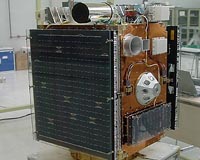
South Korea's first space rocket will send up a locally-built scientific satellite that can fuel future development of various hi-tech orbiting machines, think tanks said Monday.
The 100-kilogram Science and Technology Satellite-2 (STSAT-2) that will be sent into orbit on board the Korea Space Launch Vehicle-1 (KSLV-1) on Tuesday will carry the latest sensor arrays to collect data about the earth's radiation energy and precisely check the altitude of the satellites orbit.
Work on the STSAT-2 began in October 2002 at a cost of 13.6 billion won (US$10.8 million) with Korea Aerospace Research Institute (KARI), Korea Advanced Institute of Science and Technology and Gwangju Institute of Science and Technology taking part in the construction. The satellite was assembled in 2006 with tests conducted every six months to ensure full operational capabilities after launch.
The unit uses solar panels to generate 160 watts of electricity and has an operational life cycle of two years.
"The satellite's main mission calls for the use of microwave radiometers to check energy levels in the atmosphere, and Earth's natural radiation, while at the same time utilizing a ranging laser to measure the precise distance between STSAT-2 and ground stations on earth," a KAIST researcher said.
He added that by building the small STSAT-2, South Korea has acquired important technologies like high-precision altitude determination and control capabilities that are needed to make larger, hi-tech satellites down the road.
Since there are no available parts for satellites, local engineers had to custom-make each component.
Experts have said that while space exploration has been criticized as having a low return on investments, satellites are high value-added machines.
A one-ton communications satellite has a price tag of $8.74 million compared to $1.76 million for an aircraft engine weighing a ton, while the average cost of a vehicle weighing a ton stands at $30,000.
KARI, which has overall responsibility for the KSLV-1 and STSAT-2, said first communication will take place about 13 hours after the launch with the North American Aerospace Defense Command in Colorado being asked to find the exact orbit two to three days after the satellite has been sent into space.
In the case of contact failure, authorities said they will use an emergency beacon to determine if the satellite's systems are functioning, with signals being sent up to make contact.
Daejeon-based KARI, meanwhile, said that after sending up its first satellite into orbit on Aug. 11, 1992, the country has so far built a total of four scientific, four communications and two multipurpose satellites.
Of the total, two communications satellites are operational along with one Arirang multipurpose satellite that is equipped with high resolution cameras.
For this year, Seoul plans to orbit the Communication, Ocean and Meteorological Satellite, while two multipurpose satellites and the STSAT-3 are planned for the next few years.
Local experts, meanwhile, said that South Korea's research and development capabilities in satellites stood at 65-70 percent levels compared to leading North American and European countries. They added, however, that in some hardware areas like structural construction, South Korea has reached world class levels.
Source: Yonhap
Share This Article With Planet Earth
