
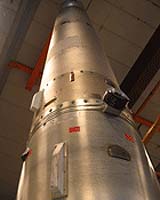
Less than four weeks remain until the sounding rocket MASER 10 will be launched from Esrange.
The rocket, which will carry five scientific experiments, has been developed at SSC's engineering centre in Solna, and is part of SSC's MASER programme for research in microgravity conditions, for ESA.
Last week, after extensive work at SSC's Solna laboratories, the rocket modules were moved to the industrial research institute STFI-Packforsk, which provides equipment for mechanical tests.
The experiment modules and the service modules were stacked, and are now going through spin balancing and mass property measurements.
Next week, electrical tests will be performed, as well as vibration tests and flight simulations, including verification of data communication with the experiment modules.
The payload consists of four experiment modules:
The BIM module houses two biological experiments for immune defence studies as well as a 1g centrifuge which is needed as a reference.
The ITEL module, which has been developed entirely by SSC, contains an experiment which will test the interfacial turbulence in evaporating liquids.
Via a direct videocam system, the scientists in charge of this experiment can study the digital image and control the experiment.
Another liquids experiment, CDIC, will study a phenomenon caused by chemical reaction between two liquids. Also in this module, there are video cameras to enable direct observations from the ground facilities.
The TRUE experiment will prove the occurence of thermal radiation forces in unsteady conditions.
The experiments are performed by scientists from Holland, Belgium, Germany and Italy.
On 11 April, the modules will be transported to the Esrange launch facilities in northern Sweden, where the rocket will be assembled. The launch is planned for 28 April.
The rocket will reach an altitude of 250 km and will provide 6 minutes of microgravity.
