
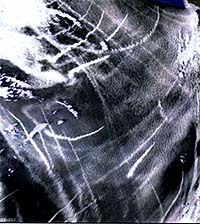
Rosenfeld used data taken by Advanced Very High Resolution Radiometers onboard several U.S. weather satellites and NASA's new TRMM satellite for his Science study.
The images showed pollution tracks caused by urban and industrial activity in areas of Turkey, Australia and Canada, as well as data indicating clouds making up the pollution tracks were prohibiting rain and snow from falling downwind from the sites.
Since each cloud droplet must form on a pre-existing particle, additional aerosols in clouds like sulfates or sulfuric acid increase the number of water droplets in clouds, said Toon.
Because temperatures and atmospheric motions driving cloud formation control the mass of water condensing in the clouds, the droplets formed on aerosol particulates tend to be smaller in size.
Clouds harboring smaller droplets have larger surface areas, making them more reflective and sending more sunlight back to space, said Toon. Because of their diminutive size, the chances of the droplets coagulating into raindrops large enough to fall as precipitation are greatly diminished.
A typical microscopic cloud droplet can travel little more than an inch through dry air before evaporating. "About 1 million cloud droplets must collide and coalesce in order to form a precipitation-sized drop," said Toon, who noted that a typical raindrop — which is about the size of a rice grain — can fall a mile before evaporating.
The rate at which droplets collide and coalesce depends on their size and the number of other similar droplets in their path, he said. Normal-sized droplets in an unperturbed cloud would sweep up about 64 times the volume of air containing other droplets than would droplets half that size inside a polluted cloud. This would make the aerosol-filled cloud much less likely to rain, said Toon.
One of Rosenfeld's satellite images shows a pollution track emanating from a mining and smelting company in Flin-Flon, Manitoba. Another shows pollution tracks from several sources near Istanbul, Turkey.
A third image shows a track originating in the vicinity of a brown coal power plant, the world's largest smelter and refinery, a huge cement plant and a major oil refinery near Adelaide, South Australia.
Other areas of the world are at least as tainted with aerosols. But pollution tracks from huge, nearly adjacent cities such as those in the Northeast United States, for example, are virtually invisible because of the perpetual pollution that hangs in the atmosphere, he said.
"Rosenfeld's work points to locales where in situ observations should be made to pinpoint the mechanisms by which pollution affects clouds," Toon concluded in Science article.
"Such knowledge may allow us to estimate how widespread the aerosol interaction with cloud precipitation may be in our globally polluted world," added Toon.
