
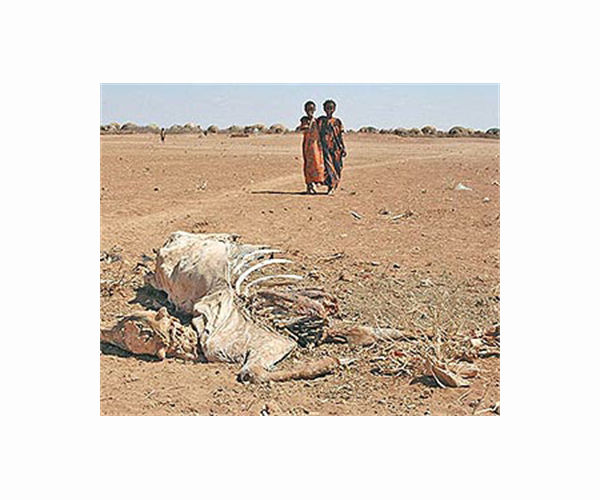
Somalia's "rapidly worsening" drought has left more than two million people facing severe food and water shortages, the United Nations said, warning of a fourth consecutive season of poor rainfall in the conflict-wracked country.
"About 2.3 million people in 57 of 74 districts… are ravaged by serious water, food and pasture shortages as water pans and boreholes have dried up," raising the risk of water-borne diseases, the Office for the Coordination of Humanitarian Affairs (OCHA) said.
The Horn of Africa was "on the verge of a fourth consecutive failed rainfall season", it added in a statement released late Thursday.
The dire situation has already forced nearly 100,000 people to flee their homes in search of food, water and pasture for their livestock, the UN agency said.
In recent years, natural disasters — not conflict — have been the main driver of displacement in Somalia, a war-torn nation that ranks among the world's most vulnerable to climate change.
"A perfect storm is brewing in Somalia," said Adam Abdelmoula, the UN resident and humanitarian coordinator for the country, calling for urgent action to prevent famine conditions from taking hold.
Somalia's minister of humanitarian affairs and disaster management Khadija Diriye warned that families could starve to death as they lose their livestock and slide deeper into poverty.
"I am particularly worried about children, women, the elderly and disabled people who continue to bear the brunt of Somalia's humanitarian crisis," she said.
Failed rains and flooding have caused widespread crop failures and piled pressure on livestock-dependent communities in Kenya and South Sudan this year.
The United Nations refugee agency UNHCR last month described the South Sudan floods as the worst seen in some areas since 1962, blaming the downpours on climate change.
Syria Kurds revive ancient rain ritual as drought bites
Qamishli, Syria (AFP) Nov 19, 2021 –
Syrian Kurds in the northeast city of Qamishli on Friday performed an ancient rain ritual that has gained new relevance as they struggle with record low rainfall.
The "Bride of the Rain" ritual, practised for centuries by the region's Kurdish community, is traditionally performed during winter to ward off drought.
A doll made of wood and colourful fabric is paraded through the street and sprayed with water while people recite special prayers.
After largely dying out in recent decades, the custom has re-emerged as drought-hit residents of Syria's northeast grapple with a growing climate disaster that has threatened their crops and livelihoods.
"We had abandoned this tradition a long time ago but we restored it in the past two years… due to severe drought," said Farhan Ahmad, 54, who owns a plot of farmland.
In the Syrian city of Qamishli, a group of children carried the doll through the streets as neighbours brought cups of water for the ritual.
An elderly man perched out the window of an empty cinderblock building delivered a rain prayer.
Hajji Suleiman, 71, said he remembered performing the same ritual as a child but that circumstances were different now.
"We have entered the middle of winter and it has not yet rained once," he said.
Najah, 34, said she had organised a feast in honour of the ceremony.
"We hope God will have mercy on us because our nation needs rain," she told AFP.
"Most of the people here are poor, some of them have not brought meat into their homes for five months."
