
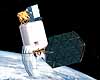
A Boeing-designed Solar Orbit Transfer Vehicle (SOTV) recently passed the first of three U.S. Air Force Technical Reviews — the Systems Requirements Review.
Boeing Phantom Works is developing the energy-efficient space vehicle
under a $48 million contract from the Air Force Research Laboratory,
Kirtland Air Force Base, N.M.
"This is a significant milestone," said Ed Cady, Boeing Phantom Works SOTV program manager. "To pass the review, we had to produce a product
development plan, define operational and space experiment requirements,
and define the technology development plan."
Boeing is developing the low-power, environmentally friendly vehicle for
both military and commercial applications. Unlike other space vehicles
that use propellant combustion, the SOTV uses solar energy to generate
both thrust and electric power.
The solar-powered vehicle operates by use of a single propellant fed
passively at low pressure into a receiver engine, heated by concentrated
solar energy to 2,500 degrees Kelvin. The heated propellant is exhausted
through a nozzle to produce low thrust (50 lb.) at high specific impulse
(800 sec).
The simple design, use of solar power and the vehicle's revolutionary
on-orbit maneuverability enables the SOTV to move payloads from Low Earth
Orbit to Geosynchronous Orbit (GEO) at a fraction of the cost of current
systems.
"This revolutionary SOTV technology has the potential for reducing total
payload delivery cost to GEO by as much as 35 percent," Cady said.
"Additionally, an operational vehicle will provide significantly increased payload capability for NASA planetary probes and human exploration missions to the moon, Mars and beyond."
Boeing engineers plan to demonstrate a complete, subscale, autonomous
on-orbit Space Experiment in late 2001 or early 2002.
SOTV Reports From Spacer.Com
