
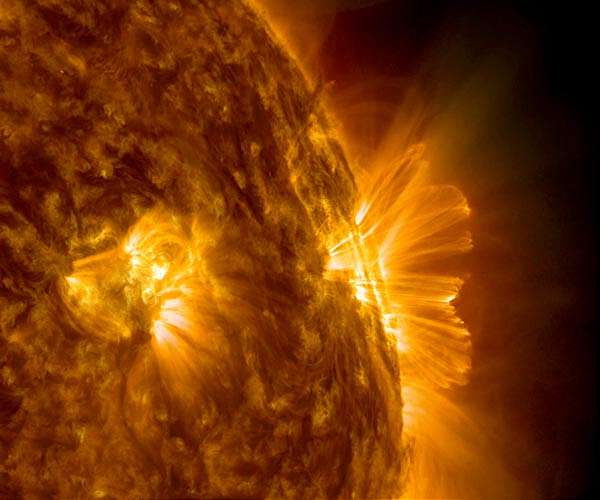
A solar flare, ejected from our sun towards the end of January, will start hitting earth Wednesday, according to the National Oceanic and Atmospheric Administration's Space Weather Prediction Center.
The flare is the result of a coronal mass ejection, a large expulsion of plasma and magnetic field from the Sun's corona, which can travel from the Sun to Earth at speeds as fast as 1,800 miles per second.
The prediction center says "a G2 (Moderate) geomagnetic storm watch is in effect due to anticipated CME arrival," beginning early Wednesday.
The G2 storm could produce auroras across the sky, from as far north as the Arctic Circle to as far south as New York City.
NOAA calculates the M1 solar flare is traveling at a speed of just over 411 miles per second, although it says "lower levels of confidence exist for intensity and arrival timing."
"M-class flares are medium-sized; they generally cause brief radio blackouts that affect Earth's polar regions. Minor radiation storms sometimes follow an M-class flare," according to the European Space Agency.
The administration says any geomagnetic storm conditions are likely to persist into Thursday, albeit at weakening levels.
CME arrival is normally first detected by NOAA's DSCOVR spacecraft, which is located approximately 1 million miles from earth.
"Much like terrestrial weather, space weather results from a complex system driven both by the Sun and events much closer to Earth," explains NASA.
