
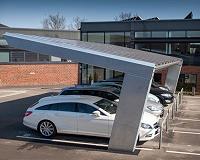
Has Japan's solar panel buildout reached its peak? If it has not, the solar carport may be the next innovation to spread across the country, further extending Japan's leading position in photovoltaic (PV) energy. 'Carport solar' – the fitting of solar panels to the roofs of outdoor parking garages – is beginning to catch on in Europe and in parts of the U.S., and is now making its way to Japan. Ambitious marketers at Hyogo Prefecture-based architecture firm Daishin International hope that their stylish designs can catch on.
Japan's rapid solar expansion appears to have been an unqualified success thus far. A record estimated 12.3 gigawatts (GW) of PV was installed in 2015. And 2016 may be even better, with another 13.2GW to 14.3GW coming on line, according to Bloomberg New Energy Finance (BNEF). The numbers mean that Japan is on track to generate as much as 25% of its national power from renewable energy sources by fiscal 2030, with 7% coming from solar.
But many experts also see 2016 as Japan's solar peak, citing challenges in grid connection, project financing, and land availability. BNEF says installations in 2017 may fall under the 10GW mark, and mark the start of a general downward trend.
Daishin salesman Jiro Shindo is among the dissenters. "We see carports as the next big thing in solar," he says at a recent renewable energy expo in Tokyo. "There remains a great deal of unused roof area in Japan's urban and suburban locations which are perfect for adding more capacity."
At its sprawling booth, Daishin, which specializes in greenhouses and other environmentally sensitive structures, showed off one of its chic carport models. Two rectangular metallic pillars built at a backward leaning angle support an inclined roof, upon which the panels lie. The company's basic lineup features similar two- and four-car versions; the basic design is Danish and the panels are German.
"Solar carports aren't for everyone, and not for every geographic area," says Mr. Shindo, noting that Daishin is primarily targeting factories and government offices with spacious parking lots where the units can be joined together to form long, continuous structures to shelter up to dozens of vehicles. Of course, the electrical output can be sold for profit back to local power providers.
From April 1, Japan's FIT (Feed-In-Tariff) for the next 12 months has been reset at 24 yen per kilowatt-hour (kWh) – an all-time low – for power coming from solar systems with 10kW or higher output capacities. But it tops out at 31-33 yen/kWh for smaller systems. The firm also hopes to capture a piece of the upper-income audience and expects to complete its first domestic installations this summer.
The strategy may pay off. In the United States, the solar carport market has found its groove as a result of average system prices that fell 51% from 2010 to 2015 and state-level incentives that have favored the preferred customer for solar carport systems: schools, government entities, and nonprofits, says Greentech Media (GTM), an online industry news source. Solar carports have also been championed by the California Division of the State Architect as a way to limit rooftop liabilities for non-residential systems.
"Turnkey prices for carport structures have fallen dramatically since 2010, and even though the majority of structural costs are tied to commodity steel, we anticipate that improved module efficiencies, lower financing costs, and increased scale and competition will push prices down another 24 percent by 2018," GTM says.
Still, the global market for solar carports remains a niche. Only 600 megawatts worth of solar canopies had been installed in the U.S. by end-2014. "Here in Japan, achieving the 1.0 megawatt level in installed output would be an outstanding accomplishment for the first year," says Mr. Shindo. "We're literally starting at zero."
