
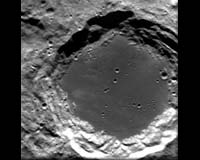
This image, taken by the advanced Moon Imaging Experiment on board ESA's SMART-1 spacecraft, shows crater Lomonosov on the Moon's far side. AMIE obtained the image on Jan. 30 from a distance of about 2,100 kilometers (1,300 miles) from the surface, with a ground resolution of 190 meters (617 feet) per pixel.
The imaged area is centered at 27.8 degrees north latitude and 98.6 degrees east longitude.
Crater Lomonosov is a nice example for a large crater – 92 kilometers (57 miles) in diameter – which was filled by lava after the impact, thus exhibiting a flat floor.
The terraced walls indicate slumping, or sliding of the rocks downward due to gravity after the end of the impact.
The small craters inside Lomonosov are the result of impacts into this lava floor which happened after the formation of Lomonosov.
Looking closely to the left half of the crater, one can see changes in the brightness of the crater floor, resembling horizontal paint strokes. These can be seen frequently in this area of the Moon and are ejecta deposits of the young crater Giordano Bruno which is about 300 kilometers (186 miles) distant.
The crater is named in honor of Mikhail Vassilievitch Lomonossov, a Russian physicist (1711 – 1765). He was professor of physics at Saint Petersburg University and devoted his life to the study of the properties of matter and electricity.
