
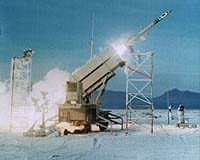
South Korea is exploring the possibility of buying U.S. Patriot PAC-3 missiles to help defend against the massive short-range ballistic missile capability of North Korea.
South Korea has asked the United States to send pricing and availability data for the Patriot Advanced Capability-3 (PAC-3) missile systems of Lockheed Martin for its surface-to-air missile procurement project, The Korea Times reported Tuesday.
The Republic of Korea's Air Force asked Lockheed Martin for the pricing and availability data in mid-November and the U.S. company plans to give the price information by next month, an official at Lockheed Martin's office in Seoul told the newspaper. The U.S. government is reviewing the data before sending it to Seoul, the official said.
The Defense Acquisition Program Administration (DAPA), in charge of the country's arms procurement affairs, confirmed the request.
"The request was made in terms of an information gathering for future negotiations on patriot missile systems," Park Sung-soo a DAPA public affairs spokesman, told The Korea Times. "However, we don't have a firm plan yet to introduce the PAC-3 system."
Under the $1 billion project, code-named SAM-X, South Korea plans to buy 48 advanced Patriot missile interceptors to replace its aging U.S.-made Nike Hercules missiles against the threat of North Korean ballistic missiles.
In 1998, North Korea successfully test-fired its Taepodong-I missile, which flew over Japan and landed in the Pacific. The communist regime is believed to be developing a longer-range missile capable of hitting the U.S. West Coast.
The South Korean government is already seeking to purchase secondhand, German-made PAC-2 GEM missiles, instead of the more modern and capable PAC-3 systems of the United States, citing financial constraints.
The PAC-3 hit-to-kill missile is the next generation surface-to-air missile being developed to provide increased capability against advanced theater ballistic missile, cruise missile and hostile aircraft. The missile kills incoming targets by direct, body-to-body impact.
A PAC-3 missile reportedly costs about $3 million in foreign military sales, while that of PAC-2 GEM is $2.4 million, The Korea Times said.
The Seoul government, in seeking greater independence from the U.S. government, has also been reluctant to introduce the new PAC-3 out of concern that it could provoke anti-American sentiment in the country, the newspaper said.
Source: United Press International
