
Bok choy emojis, clips of Gucci gift bags stuffed with celery and video of drones delivering broccoli — vegetable memes are the new currency in Shanghai's sardonic social media scene, with the city locked down and pining for greens.
Those navigating the city's thicket of Covid-19 restrictions to go shopping this week found long queues and empty shelves as panic-buying outpaced re-supply.
The online market was a little better stocked, with fresh food apps Hema and Ele.me crashing as early risers refreshed pages the moment stores opened.
The vegetable hysteria was picked up by meme-makers who tickled image-conscious Shanghai with videos of Louis Vuitton boxes holding bok choy instead of luxury items, and clips on Douyin — China's TikTok — showing lettuce, cucumber and celery in Gucci gift bags.
Another unverified but widely shared video shows a man delivering a bag of broccoli via drone to a grateful neighbour.
Shanghai authorities have recognised that patience is running thin after three weeks of scattergun lockdowns and restrictions, promising people will have fresh food packages.
State media on Thursday moved to reassure the public that fresh produce would not run out, showing photos of "vegetable planting bases" in the Shanghai suburbs running "round-the-clock" to meet the demand spike.
Fresh food costs tripled in some markets due to panic buying and a lack of delivery drivers.
Residents are growing weary and frustrated at the failure to control a virus outbreak in which cases are "rapidly rising", city authorities warned.
"It's been much more difficult to buy groceries on Hema," a 42-year-old locked-down Shanghai resident, who gave her name only as Tang, told AFP.
"Some of the things I wanted were not there, and of course the delivery times are much, much longer."
Lockdowns have extended beyond their initial periods and many residents are concerned a positive test could see them swept into state quarantine.
"Our compound had around 20 confirmed cases… We can't go downstairs of our building," said a finance worker locked down in Pudong.
The man, who declined to give his name, said he had received a "package of vegetables, so we don't lack any now".
As the city entered a period of anxiety and confusion over the lattice of lockdown rules, AFP reporters saw people surreptitiously buying vegetables through a gate sealed by police tape, and people hauling groceries up to a balcony on a string.
A stream of the Miami Ultra Music Festival, hosted by Chinese platform TudiMusic, was blitzed with vegetable emojis from Shanghai viewers during replays this week.
TudiMusic said hundreds of thousands of viewers from the city tuned in.
Shanghai residents frustrated by food shortages, prolonged lockdowns
Shanghai (AFP) April 1, 2022 –
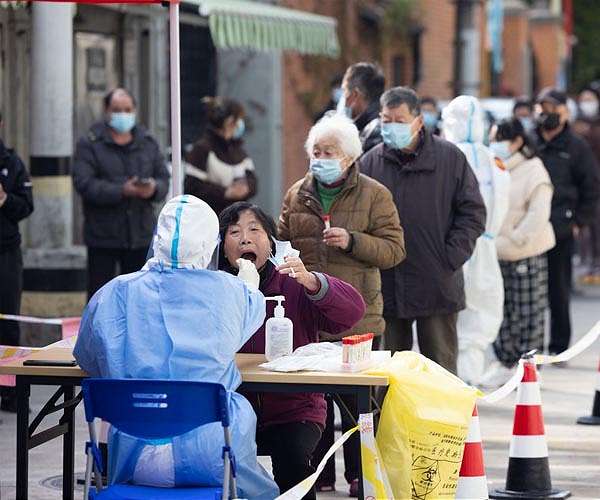
Shanghai residents voiced frustration Friday at a week of snap Covid lockdowns, complaining online about food shortages and bewildering stay-at-home orders.
After initially vowing they would avoid a city-wide lockdown, officials changed tack this week and announced a phased shutdown which divided China's financial centre in two so authorities can test its 25 million residents.
A four-day lockdown of the Pudong area began on Monday, followed by stay-at-home orders for the densely populated Puxi zone that were meant to start on Friday.
But people in many Puxi neighbourhoods were suddenly ordered inside early on Thursday, while much of Pudong remained closed on Friday, angering residents on both sides.
"This is de facto city-wide lockdown," one Weibo user said. "Many Pudong streets and compounds are still in lockdown, few are lifted."
Authorities late Thursday published a complex "grid management" plan for reopening that would keep all residential compounds closed where a positive test is found.
The restrictions have led to panic-buying and a dire shortage of delivery drivers to get food to the millions now trapped at home.
Residents of some buildings have skirted restrictions by taking deliveries attached to ropes lowered to the ground, according to AFP reporters.
"It's complicated to buy food online, because the number of delivery people is limited," said Sun Jian, 29, a resident in Puxi.
She added that the lockdown had been "badly managed" as people were forced to queue together for Covid tests, adding to the risk of transmission.
"What everyone is most afraid of now is not getting sick, but being sent to isolation rooms in makeshift facilities, where the conditions are very bad," she told AFP.
A Pudong resident surnamed Dong said his wife and three-year-old son were taken to centralised quarantine after testing positive, but have no access to hot water.
"No one tells us when the quarantine will be lifted," he told AFP.
"I'm quite anxious."
– 'Dynamic zero' policy –
China reported nearly 104,000 domestic Covid infections in March, with 90 percent of the recent cases found in Shanghai or northeastern Jilin province, health officials said Friday.
National Health Commission spokesman Mi Feng told a press briefing it remains necessary to "unswervingly" adhere to the "dynamic zero" policy of stamping out clusters as they emerge.
But other experts cautioned this may take time given the infectiousness of the Omicron variant and number of asymptomatic cases.
As patience starts to fray in Shanghai among a public who until now have broadly acquiesced to virus controls, top city official Ma Chunlei on Thursday made a rare admission of failure, saying the city was "insufficiently prepared" for the outbreak.
Shanghai is recording several thousand cases a day, making it the heart of China's worst Covid-19 outbreak since the country's first brush with the virus in Wuhan was controlled in early 2020.
More than 7,300 virus cases were recorded nationwide on Friday. While tiny compared with many countries, the case numbers are alarming to China's leadership, who have tethered the nation to a "zero-Covid" approach.
