
With service turned up early Thursday morning aboard AMC-11, in its orbital position 22,000 miles above North America, cable programmers are now in a better position to meet growing consumer demand for high-definition television (HDTV) entertainment.
SES Americom, an SES Global company Friday announced initiation of service aboard the A2100 Lockheed Martin spacecraft, that began at 4:00 a.m., completing HD-PRIME, America's only two-satellite HD cable neighborhood that reaches over 80 million homes.
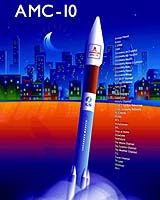
Leading programmers began distribution aboard HD-PRIME in May, when AMC-11's identical twin satellite, AMC-10, kicked off service for the first time. As of the wee hours of Thursday morning, both advanced, HD-PRIME satellites are providing reach to every cable household in the U.S.
"The cable industry woke up Thursday morning to a whole new era of HD distribution, aboard a first-of-its-kind HD-optimized cable neighborhood that offers the most robust, reliable platform with the broadest reach available today," said Bryan McGuirk, senior vice president, Americom Media Services, SES Americom.
"HD-PRIME is the only cable neighborhood that puts programmers and producers right where they want to be; in the living room of every cable subscriber in the country with the HD entertainment they want to see."
Capacity is still available for additional residents, despite a growing list of leading programmers already distributing dozens of standard and high-definition channels aboard HD-PRIME, including Discovery Communications, Viacom, E! Networks, A&E Television Networks, C-SPAN, Court TV, Hallmark Channel, iN DEMAND, Lifetime Entertainment, NBC, QVC, Scripps Networks, and The Weather Channel.
The HD-PRIME Satellites
AMC-10 and AMC-11 are all C-band satellites, which operate from 135 and 131 degrees west longitude, respectively. The two A2100 spacecraft, built by Lockheed Martin Commercial Space Systems, have been optimized for next-generation programming services, including high-definition channels.
Each of the 24 transponders is supported by a 20 watt SSPA, delivering almost a 20% increase in power over their predecessors, Satcom C-3 and Satcom C-4. In addition, a higher level of on-board redundancy plus an in-orbit satellite, AMC-7, currently operating at 137 degrees west longitude, protect the cable programming services.
