
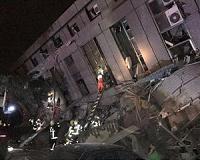
Rescuers Sunday ended their search of a Taiwan building partially toppled by a 6.4-magnitude earthquake as the last trapped pair were presumed dead, bringing the final death toll to 17.
Thousands of emergency workers had combed through rubble at the foot of the 12-storey Yun Tsui apartment block since the quake struck the eastern city of Hualien late Tuesday.
It was left leaning at around a 50-degree angle by the quake, complicating rescue efforts due to fears of an imminent collapse.
Hualien mayor Fu Kun-chi said the last two victims were pinned under heavy pillars that could not be removed without risking a total collapse of the building, and the rescue was called off with the consent of their relatives.
Excavators began digging through the building from the top later Sunday to try to recover the bodies, he added
"Seventeen people were unfortunately killed in the earthquake … I believe their relatives will receive proper assistance," Premier William Lai said while paying his respects to victims in Hualien Sunday.
The last pair are believed to be members of a family from Beijing who arrived in Taiwan on Monday, authorities said. The bodies of three other members of the family including a boy aged 12 were recovered Saturday.
They were staying in a second-floor room at a hotel in the Yun Tsui building when the quake struck.
Fourteen of the 17 people who were killed perished in the building.
Three partially collapsed buildings in Hualien are being demolished, including the local landmark Marshal Hotel where one employee was killed.
Hualien, on Taiwan's picturesque east coast, is one of the most popular tourist destinations in the quake-probe island.
Taiwan's worst tremor in recent decades was a 7.6-magnitude quake in September 1999 that killed around 2,400 people.
That quake ushered in stricter building codes but many of Taiwan's older buildings remain perilously vulnerable to even moderate tremors.
3D survey details dangerous megathrust fault off Costa Rican coast
Washington (UPI) Feb 12, 2018 -Scientists have a better understanding of the dynamics of a dangerous megafault off the coast of Costa Rica, thanks to a new survey by researchers at the University of California, Santa Cruz.
The survey yielded detailed 3D images of the Costa Rican subduction zone, where the Cocos plate sinks and slides under the Caribbean plate.
Unlike similar megathrust faults, the Costa Rican fault features unusual earthquakes, patchy in their distribution. The ruptures rarely spread to shallow depths. Scientists believe the fault's odd behavior is explained by its varied textures — corrugated patterns created by subduction activity.
"Our new imagery shows large variability in the conditions along the megathrust, which may be linked to a number of earthquake phenomena we observe in the region," Joel Edwards, a doctoral candidate in Earth and planetary sciences at UC Santa Cruz, said in a news release.
Megathrust faults are capable of producing some of the largest earthquakes in the world. The seismic energy can also trigger tsunamis, threatening nearby coastal communities. Understanding the mechanics of megathrusts can help scientists more accurately estimate the risks facing local populations.
Scientists used advanced acoustic imaging technology to survey the corrugated ridges, or grooves, along the interface of the two plates. The patterns are similar to ridges found at the terminus of quickly receding glaciers.
The 3D images — detailed in the journal Nature Geoscience — revealed unique combinations of smooth expanses and textured ridges.
"This study produced an unprecedented view of the megathrust. Such 3D information is critical to our ability to better understand megathrust faults and associated hazards worldwide," said Jared Kluesner, a geophysicist at the U.S. Geological Survey in Santa Cruz.
Scientists hope to learn more by drilling into the fault, but researchers had to conduct a 3D survey first before drilling at significant depths.
"At present, two drilling expeditions have been accomplished with shallower targets, and, though not yet scheduled, we are hopeful that the deep drilling will occur," said Eli Silver, planetary sciences professor at UC Santa Cruz.
