
Swedish neuroscientists say they have demonstrated, for the first time, that people can perceive another body to be their own.
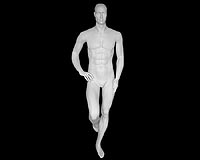
Valeria Petkova and Dr. H. Henrik Ehrsson of the Karolinska Institute in Stockholm, Sweden, conducted five experiments, during which participants wore a head-mounted video display that showed high-fidelity, stereoscopic images taken from cameras in the eyes of a life-sized, male mannequin.
Asked to tilt their heads downward, the participants saw the mannequin's body respond but not their own. Responses to a questionnaire showed that participants perceived the mannequin's body as their own when a rod simultaneously stroked the abdomen of the participant and the mannequin, the researchers said. And when experimenters threatened the mannequin with a knife, participants displayed a physiological response to the threat.
The scientists said the illusion "was so strong that people could experience being in another person's body when facing their own body and shaking hands with it."
The scientists concluded that to create the illusion, there had to be (1) a continuous match between visual and tactile cues about the body; (2) the use of a "sufficiently humanoid body;" and (3) images corresponding to what one would see from the eyes of the other body.
The study is detailed in the online journal PLOS One.
earlier related report
Couples ambivalent about surplus embryos
A study of patients at nine fertility clinics in the United States finds that many couples are unhappy with the available alternatives for surplus embryos.
More than 1,000 couples were surveyed for the study led by Anne Lyerly of Duke University, USA Today reported. More than half said that they were unlikely to donate embryos they did not need to another couple.
That finding was surprising, given the terms of the debate on in vitro fertilization and the fate of embryos couples do not need, Lyerly said.
"If you look at the policy debate and the discussion in the literature, there is a presumption that if you respect or care about an embryo, you would want it to become a child," Lyerly said.
Forty percent of the couples who said they did not want more children said they would prefer to donate surplus embryos for research, as did 15 percent who were considering more children. But the federal ban on funding for research on embryos means many clinics do not offer that choice.
Many couples simply leave the embryos in storage, paying fees indefinitely, Lyerly said. She said couples appear to feel responsible for those embryos to the point of not wanting to let them go to unknown parents.
Share This Article With Planet Earth
