
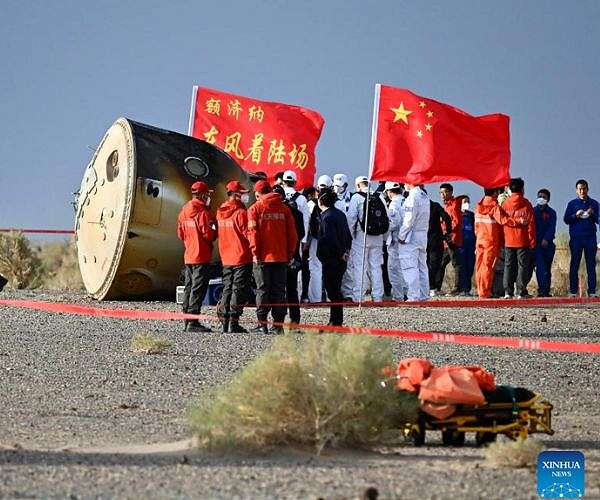
In a recent development from China's ambitious space program, the Shenzhou-15 manned spacecraft has successfully returned to Earth with a collection of experimental samples originating from the Tiangong space station. As announced in Monday's Science and Technology Daily report, the samples are set to significantly contribute to various scientific research projects.
The samples were delivered to the team at the space application system, who are tasked with further research and analysis. An array of experiments and research studies have been scheduled to make full use of the samples.
As per the report, the returned cargo carried samples from 15 distinct scientific projects, symbolizing a commendable achievement for China's space exploration efforts. With a total weight exceeding 20 kilograms, the samples will be instrumental in both life experiments and material experiments.
Scientists are poised to embark on a series of analyses using these samples. Molecular and cell biology will be studied, and assessments of in-orbit growth and metabolism are planned. These life experiments promise to offer valuable insights that are unattainable in typical terrestrial laboratories.
Concurrently, the material experiments will focus on the examination of physical properties and the detection of chemical alterations within the samples. It is expected that these studies will further our understanding of how certain materials behave in a microgravity environment, a domain which is inherently challenging to replicate on Earth.
The Shenzhou-15 mission concluded with the spacecraft's return capsule landing at the Dongfeng site in China's Inner Mongolia Autonomous Region. The touchdown was confirmed at 6:33 a.m. Beijing Time last Sunday, marking another successful mission for China's expanding space program.
