
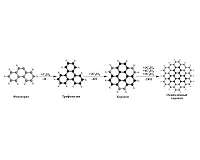
The international team of scientists proposed a sequence of transformations starting from a chemical compound – a triphenylene molecule – to graphene nanoparticles, soot, and carbon dust, which are building materials for a considerable part of meteorites.
The team of scientists of Samara National Research University, Florida International University, the University of Hawaii and Lawrence National Laboratory (Berkeley) proposed and during the experiment confirmed the formation mechanisms of the primary building block for a part of meteorites and planets – triphenylene molecules. The results of the study are published in the article "Gas-Phase Synthesis of Triphenylene (C18H12)" and placed on the cover of the high ranking journal ChemPhysChem.
Triphenylene is a key element around which larger graphene-like structures are formed, which then gradually "stick together" into layered nanoparticles. The latter, colliding with each other, are combined into particles of soot and carbon dust. Due to gravity, dust is collected in the simplest meteorites – carbonaceous chondrites, and then in other, larger celestial bodies, including planets.
The formation mechanism of triphenylene was confirmed by quantum-mechanical calculations carried out by a team of Samara University scientists from the research laboratory "Physics and Chemistry of Combustion", supported by the megagrant of the Russian government "Developments of Physically Grounded Combustion Models" (grant No. 14.Y26.31.0020). The aim of the research is to study the formation mechanisms of harmful substances in combustion chambers, which include polyaromatic hydrocarbons (PAHs), nanoparticles and soot.
"In fact, we have found one of the starting mechanisms for reactions that trigger the formation of nanoparticles, soot and carbon dust both in the combustion chambers of engines and in the molecular clouds of the galaxies," – said Head of Samara University Physics and Chemistry of Combustion Laboratory, Professor of Florida International University Alexander Mebel.
The calculations showed that the process of triphenylene formation can proceed not only in flames at high temperatures, but also in conditions of extra-low temperatures in interstellar space, triggering the growth mechanism of flat polycyclic aromatic hydrocarbons (PAHs) up to nanoscale particles.
In addition, as it is shown by the analysis carbonaceous chondrides having flown to the Earth from space, their composition contains the entire spectrum of particles, ranging from simple PAHs to graphene nanoparticles.
"Our work aroused wide interest of the scientific community not only because we found the mechanism of formation of the triphenylene molecule, but we also determined all the kinetic constants of the processes involved in this reaction", – added Alexander Mebel.
For this reason, the data obtained during the study, according to the Professor of Florida International University, will be in demand both by design engineers for creating environmentally friendly combustion chambers of aircraft and automobile engines operating on hydrocarbon fuels, and by scientists who are studying the formation of various galactic macrostructures from molecular clouds.
