
South Korea said Monday it would not switch off propaganda broadcasts unless Pyongyang offered a "clear apology" over a series of alleged provocations, as the two Koreas were locked in negotiations to end a military standoff.
The remarks from South Korean President Park Geun-Hye came even as top-level representatives from both countries engaged in marathon talks which began Saturday in the border truce village of Panmunjom, where the 1950-53 Korean War ceasefire was signed.
But hope over the outcome of the latest talks was clouded by South Korean claims that the North was seeking to influence the negotiating process with provocative military movements, including moving additional artillery units to the border and deploying dozens of submarines.
"(North Korea) should make a clear apology… and ensure that there will be no further provocations," Park said in a speech, blaming Pyongyang for sparking the current military crisis with "provocative activities".
The South's defence ministry, meanwhile, said the North had doubled its artillery units at the border and deployed two-thirds of its total submarine fleet — around 50 vessels — outside their bases.
The ministry said it was closely monitoring the movement of North Korean landing craft, following a report by the Yonhap news agency that the North has deployed about 10 air-cushioned amphibious landing craft carrying special forces to a frontline naval base.
"The North is adopting a two-faced stance with the talks going on," said a ministry spokesman who described the scale of the movement as "unprecedented".
The negotiations in Panmunjom are being led by South Korean National Security Adviser Kim Kwan-Jin and his North Korean counterpart Hwang Pyong-So — a close confidant of leader Kim Jong-Un.
The gruelling hours reflect the challenge of reaching a compromise, with both militaries on maximum alert and flexing their weaponry across a border that has already seen one exchange of artillery fire.
While the North moves around subs and artillery units, South Korean and US fighter jets have been carrying out simulated bombing sorties not far from the border.
– Landmine blasts –
The roots of the standoff lie in landmine blasts on the border this month that maimed two South Korean soldiers.
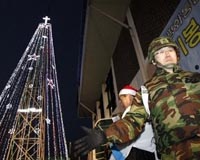
Accusing Pyongyang of laying the mines, Seoul retaliated by switching on giant banks of loudspeakers that had lain silent for more than a decade, blasting high-decibel propaganda messages into North Korea.
The North denied any role in the mine blasts and issued an ultimatum for the South to halt its "psychological warfare" or face attack.
Analysts said the North would never apologise for the mine blasts, while South Korea would reject any compromise that might be seen to reward Pyongyang's belligerence.
"The two sides may be able to come up with a statement in which some sort of 'regret' is expressed without explicitly naming the North," said Jeung Young-Tae, an analyst at the Korea Institute for National Unification in Seoul.
"But I don't think such a vague statement will work this time," Jeung said, stressing that the case of the maimed soldiers — both of whom lost legs — had become an emotional issue in the South.
"So I think the best outcome of this meeting will be an agreement for another high-level meeting in the future, such as defence ministerial talks," he added.
That would still leave open the issue of the propaganda broadcasts, which Seoul has vowed to continue.
UN Secretary General Ban Ki-moon, a former South Korean foreign minister, urged both sides to "redouble" their efforts to reach a compromise.
Technically, the two Koreas have been at war for the past 65 years, as the Korean War ended with a ceasefire that was never ratified by a formal peace treaty.
There are nearly 30,000 US troops permanently stationed in South Korea, and the US military's top officer on Saturday reiterated Washington's commitment to the defence of its ally.
South Korea's defence ministry said Seoul and Washington would discuss the possible deployment of strategic US military assets on the peninsula.
Resuming a 60-year shouting match
Seoul (AFP) Aug 22, 2015 –
In a modern, high-tech world of sophisticated, subliminal messaging, screaming taunting messages over banks of loudspeakers seems like a decidedly old-school style of propaganda.
Retro or not, it has proved effective enough to prompt North Korea to threaten war if South Korea does not switch off the speakers it recently dusted off and retrieved from the military attic to harangue its rival across the border.
The use of loudspeakers to deliver high-decibel threats and taunts goes back to the 1950-53 Korean War, when mobile units with mounted megaphones would try to keep pace with the conflict's rapidly and wildly shifting frontline.
In his book, "Cease Resistance: It's Good for You," Stanley Sandler, a historian for the US Army Special Operations Command, noted that the messages blasting out from North Korean propaganda units were about as sophisticated as their equipment.
"You have expended all your left-over equipment from World War II. It will start costing you to continue," was one less-than-morale-shattering effort aimed at US troops.
After the war cemented the division of the Korean peninsula, North and South continued the loudspeaker battle, mixing it up with radio broadcasts and aerial leafleting.
– Changing themes –
The themes favoured by both sides were initially quite similar — the iniquities of their respective socialist and capitalist systems, the mendacity of their respective leaders and the comforts to be found on their respective sides of the border.
In the 1980s and 90s when the South Korean economy really took off, the message from the South changed as it increasingly trumpeted its success and affluence, while the North struggled with hunger and deprivation.
With the election of Kim Dae-Jung as South Korean president in 1998, the content changed again, as Kim's "Sunshine Policy" of engagement with the North brought in a softer tone.
A former South Korean conscript of the time, who saw out his two-year military service with a border propaganda unit, said the daily diet was largely titbits of news and pop songs — old and new.
In many ways, he recalled, the main priority was just to make some noise.
"We used to broadcast for 15 hours throughout the night into the following morning," the former soldier, who declined to be identified, told AFP.
– Football propaganda –
Another military official recalled how commentary on some of the matches during the 2002 World Cup — co-hosted by South Korean and Japan — was broadcast live over the speakers to North Korean military units.
"When we asked them through the loudspeakers whether they enjoyed it, we could see some signalling back their approval — waving their arms in circles," the official told online news provider Media Today.
A single battery of loudspeakers could stand as much as 10 metres (30 feet) high, with 70-80 units piled on top of each other.
"The impact was greater than you may expect," said Ju Seung-Young, a former North Korean soldier assigned to a unit on the western front before he defected to the South in 2002.
"The South Korean loudspeakers were a rare source for news about the outside world," Ju told the Dong-A Ilbo newspaper.
"At first, I thought their broadcasts were all lies. But after being exposed for two years straight, I began to believe it," he added.
Although the South's loudspeaker units were about 4.5 kilometres (three miles) away, Ju said the messages could be clearly heard.
By contrast, the North Korean propaganda unit Ju was assigned to had poor equipment and suffered constant power shortages that made it impossible to compete with the South's powerful output.
– Speakers fall silent –
Eventually, with Kim Dae-Jung's presidential successor Roh Moo-Hyun continuing the engagement policy, the loudspeakers on both sides fell silent by mutual consent in 2004.
Seoul had threatened to resume the campaign in 2010 after the sinking of a naval corvette that was blamed on a North Korean submarine.
Although the loudspeakers were re-installed, they were never put back into use as Seoul limited itself to a number of direct FM radio broadcasts into North Korea instead.
But now they are back, blaring out a mixed bag of content from weather reports to snippets of news and messages about democracy.
"South Korea regards propaganda loudspeakers as an effective tool to depress the morale of North Korean troops," a foreign ministry official told AFP when asked what genuine impact resuming the broadcasts could really have.
Just how depressed the troops might be is open to question. North Korea's fury at the loudspeakers being switched back on, is not.
