
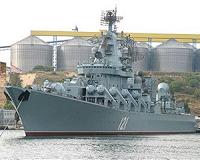
Two Russian ships in the Mediterranean on Friday launched long-range cruise missiles against jihadist targets in Syria as part of Moscow's bombing campaign in support of the Syrian regime, the defence ministry said.
Russia's navy fired the missiles on Friday morning in its first use of cruise missiles against Syria since December last year.
It said two of its Buyan-class corvettes including its new Zelyony Dol patrol ship staged three launches of Kalibr cruise missiles against targets in Syria linked to the former Al-Nusra Front group, which has renamed itself Fateh al-Sham Front.
The defence ministry posted video footage on its YouTube page of the ships firing the missiles into a clear blue sky.
The missiles destroyed a command centre and a "terrorist base" close to Daret Ezza west of Aleppo and also an arms factory making mortar munitions and a large arms storage facility in the Aleppo province, the ministry said in a statement.
Moscow said it fired the missiles on a trajectory going over uninhabited areas for safety reasons, adding that "according to objective monitoring" they destroyed the targets.
Russia dispatched the Zelyony Dol corvette, built last year, to the Mediterranean in February after it joined the Black Sea fleet based in Crimea in December.
The Russian navy used cruise missiles to strike Syria for the first time last October, launching them from the Caspian Sea, as well as in December, when they were launched from a submarine in the Mediterranean.
Just like Omran, children bear brunt of Syria war
Beirut (AFP) Aug 19, 2016 –
The haunting image of Omran, a little boy mutely caked in blood and dust following an air strike, has become the latest symbol of Syria's war and its devastating impact on children.
Footage of the shell-shocked four-year-old made headlines around the world and Omran was dubbed by Washington as "the real face" of the conflict.
Only in September 2015, Aylan Kurdi, a three-year-old whose tiny body washed up on a Turkish beach after a desperate attempt by his Syrian family to reach Europe by boat, focused global attention on the crisis faced by refugees fleeing Syria.
For every Omran and Aylan, there have been hundreds of thousands of children killed, maimed and traumatised by the relentless violence.
– No room for children –
Some 3.7 million children have been born since Syria's war started in March 2011, according to the UN's child agency UNICEF. They have grown up knowing nothing but fighting, fear and upheaval.
A total of 8.4 million children — 80 percent of all Syrian children — have been affected by the conflict, whether in Syria or as refugees, UNICEF says.
– Nearly 15,000 children killed –
According to the Syrian Observatory for Human Rights, a monitoring group, more than 14,700 children have been killed since 2011. Most died in bombardments.
Dozens have also died of hunger or due to a lack of access to healthcare in regions under siege. Others lost their lives in gas attacks.
According to the Save the Children charity, children represent 35 percent of victims in the besieged northern city of Aleppo.
– Hundreds of thousands under siege –
According to UNICEF, half of the nearly 600,000 Syrians under siege are children, some forced to eat animal feed and leaves just to survive.
Human Rights Watch says at least 1,433 children have been jailed since the start of the war, of whom only 436 have been freed.
Among the thousands of tortured detainees photographed by "Cesar", an anonymous Syrian photographer who managed to smuggle images of prison abuse out of Syria, 100 of those maltreated were boys aged under 18.
They included 14-year-old Ahmed al-Musalmani, arrested in 2012 when Syrian soldiers found a song on his mobile phone criticising the regime of President Bashar al-Assad. He died in prison.
– 2.8 million denied schooling –
In March, UNICEF said that 2.1 million children within Syria could no longer go to school.
In neighbouring countries, where Syrians have taken refuge, more than 700,000 Syrian children do not have access to education, especially in Turkey and Lebanon where schools are overwhelmed and lack means.
In Lebanon, many children are forced to work or beg and most go without schooling.
Syria's war has left more than 290,000 people dead and driven millions from their homes.
