
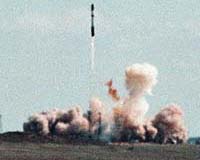
Russia's threats to target with ballistic missiles any Polish or Czech sites involved in a future US missile defence system are "uncalled for," a NATO spokesman said Monday. Earlier Monday General Nikolai Solovtsov, head of Russia's strategic missile force, threatened a tough response if the United States went ahead with its plan to site a missile defence system in Poland and the Czech Republic.
Russia, he said, could easily restart production of medium-range missiles if the decision were taken to withdraw from the Cold War-era Intermediate-Range Nuclear Forces Treaty (INF), signed by Moscow and Washington in 1987.
"This kind of extreme language is uncalled for" said James Appathurai, spokesman for North Atlantic Treaty Organisation (NATO) chief Jaap de Hoop Scheffer, in Brussels.
The United States has said it wants to begin formal talks soon on deploying a missile defence system comprising missiles to be sited in Poland and a radar station to be sited in the Czech Republic.
Washington says the aim would be to intercept potential attacks from Iran and North Korea.
The anti-missile system in question is a strictly US idea and not linked to NATO, which is quick to stress that any related negotiations with Prague or Warsaw are strictly bilateral with Washington.
However all three countries are NATO members.
earlier related report
Russian general threatens tough response to US missile shield
Moscow (AFP) (SPX) Feb 20 – A Russian general threatened on Monday a tough response if the United States goes ahead with a plan to site a missile defence system in Poland and the Czech Republic. "If the governments of Poland and the Czech Republic take such a decision, the strategic missile force will be able to aim at these installations," said the force's head, General Nikolai Solovtsov.
Russia, he said, could easily restart production of medium-range missiles if the decision were taken to withdraw from a Cold War-era treaty, the Intermediate-Range Nuclear Forces Treaty (INF), signed by Moscow and Washington in 1987.
"If the political decision is taken to withdraw from this treaty the strategic missile force will be ready to fulfil this task," Solovtsov said at a news conference.
While Russia had destroyed all its medium-range missiles under the treaty, "all the technical documentation remains and restarting their production will not be difficult," he said.
The United States has said it wants to begin formal talks soon on deploying a missile defence system comprising missiles to be sited in Poland and a radar station to be sited in the Czech Republic.
Washington says the aim would be to intercept potential attacks from Iran and North Korea.
But Moscow does not accept this, saying that the system, close to Russia's western borders, would threaten Russia.
The INF was recently described as a "relic" of the Cold War by Sergei Ivanov, formerly Russia's defence minister and now a first deputy prime minister.
On Monday Czech Prime Minister Mirek Topolanek said both his country and Poland were "likely to give a positive answer" to Washington's request.
earlier related report
Russian Withdrawal From INF Treaty Would Be A Problem And Gates
Washington (AFP) Feb 15 – Russia's withdrawl from a Cold War-era treaty limiting short and medium range missiles in Europe would be "a problem" for the United States and especially Europe, US Defense Secretary Robert Gates said Thursday. He was responding to a warning by Russia's military chief that Moscow could withdraw from the treaty if the United States deploys missile defense systems in Poland and the Czech Republic.
Gates said US missile defense was a "false issue" and that a likelier reason Moscow would consider such a step is its concern about the developing threat of ballistic missiles from the east and the south of Russia.
Russian abrogation of the treaty "is a problem for us," Gates told reporters here. "I think that the Europeans will have a special problem with it."
General Yury Baluyevsky told Russian news agencies that Moscow or Washington were entitled to withdraw from the INF treaty, if there was "convincing proof" of the need to do so.
With several countries currently developing medium-range missiles, "such proof exists," he told Interfax.
He said Russia's decision could hinge on US plans to install missile defence sites in central Europe — plans that Moscow strongly opposes.
"We will see how our American partners act in future. What they're doing today, creating an… anti-missile defence region in Europe, is inexplicable," said Baluyevsky.
The general's remarks comes only days after Russian President Vladimir Putin delivered a scorching speech in Munich that attacked US global leadership, NATO's eastward expansion toward Russia and US missile defense plans.
"They know perfectly well that the ballistic missile defense that we're contemplating and proceeding to negotiate in Europe is no threat to Europe, is no threat to Russia," Gates said.
"I think that, interestingly enough, given their concerns that they say they have about our ballistic missile defense, I think that they are concerned about the developing medium-range ballistic missile threat to their south and to their east," he said.
"And I think, if they have concerns with the INF treaty, it probably derives from that," he said.
Source: Agence France-Presse
