
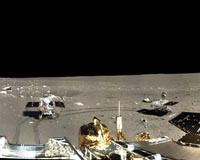
Russia's Lavochkin Research and Production Association is ready to work with China on designing lunar exploration missions, including orbital and return ones, Sergei Lemeshevsky, the Russian company's director general, told Sputnik on Thursday.
Xu Yansong, the head of the International Cooperation Department of the China National Space Administration (CNSA), said on Wednesday that China and Russia were in talks on lunar exploration cooperation, because China's Chang'e-4, Chang'e-5, Chang'e-6 missions were quite similar to Russia's Luna-26, Luna-27, Luna-28.
"Variants of cooperation on spacecraft Luna-Resurs (Luna 26/27) and Luna-Grunt (Luna-29) actually exist, we are ready to discuss the variants of mutual cooperation," Lemeshevsky said.
The head of the Russian company noted that the firm was working closely with the European Space Agency (ESA) on Luna-Glob (Luna-25), which is supposed to launch in 2019 and to perfect soft-landing technologies.
"At the moment, the cooperation with China on Luna-Glob is not very likely because we have already made a great progress [with the ESA], a new partner would require augmenting the spacecraft, which may delay the launch deadlines," Lemeshevsky said.
Chinese Lunar exploration program includes three stages, beginning with orbital missions (Chang'e-1, Chang'e-2), followed by soft landers and rovers (Chang'e-3, Chang'e-4) and concluding with a return mission (Chang'e-5, Chang'e-6).
Russian program includes the launch of lunar orbiter Luna-26 in 2020, to do remote research, while Luna-27 lander mission is planned for 2021.
Luna-29 sample return mission is planned for 2024.
New NELIOTA project detects flashes from lunar impacts
Using a system developed under an ESA contract, the Greek NELIOTA project has begun to detect flashes of light caused by small pieces of rock striking the Moon's surface. NELIOTA is the first system that can determine the temperature of these impact flashes.
Studies such as NELIOTA are important because Earth and its Moon are constantly bombarded by natural space debris. Most of this mater … read more
