
Russian space engineers are designing a next-generation, super-heavy booster rocket, local media reported Tuesday.
Anatoly Kuzin, deputy general director of the Khrunichev State Research and Production Space Center, was reported by the ITAR-TASS news agency as saying the center is working on a three-stage rocket capable of lifting 110 tons of payload into low-Earth orbit and providing materials for assembling future space stations there.
All manned spaceflights currently are limited to low-Earth orbit, between 210 miles and 840 miles in altitude.
The rocket's four-chambered RD-170 engine will be used in the first stage, Kuzin said, followed by the RD-180, a two-thrust-chamber derivative of the RD-170, for the second stage. The third stage will have the one-chamber RD-0122 engine.
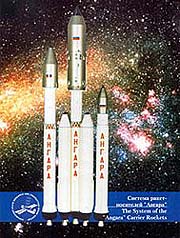
The center's existing Angara rockets, which are designed for heavy lift and similar to the U.S. Evolved Expendable Launch Vehicle, or EELV, can lift a maximum of 27 tons of payload into low-Earth orbit.
