
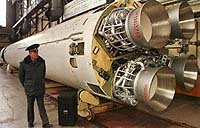
The Russian Strategic Rocket Forces on Wednesday carried out one more intercontinental ballistic missile training launch, RSRF spokesman Ilshat Baichurin has told Interfax.
An RS-18 missile (SS-19 Stilleto missile under Western classification) was launched from a silo at the Baikonur state training ground at 1 p.m., Moscow time, on November 1.
The missile had been in the arsenals of a Russian strategic missile unit for 25 years, Baichurin said.
Commander of the Russian Strategic Rocket Forces Vladimir Yakovlev said that the recent fifth training launch of a ballistic missile had the following tasks: to check the Russian Strategic Rocket Forces' readiness to honor its international obligations under the START treaties and to confirm the design and technical method of using intercontinental ballistic missiles of this type in a single-warhead variant.
Also, the missile's tactical and technical characteristics were confirmed, including the reliability of a missile complex with an extended service life.
Baichurin said that pre-launch operations, the launch itself and the missile flight were in strict accordance with the program and that the training target was hit on the Kura testing ground in Kamchatka.
The Russian Strategic Rocket Forces have made four ballistic missile launches in September to October, 2000: the first training launch from a Topol-M mobile missile system, the eleventh Topol-M launch from a silo, the 71st launch of a Topol intercontinental ballistic missile from the Plesetsk cosmodrome, and the launch of an RS- 20 (Satan) intercontinental ballistic missile with five satellites from the Baikonur cosmodrome.
Meanwhile a Russian military spokesman said Russia will keep RS-18 (SS-19 Stilet) intercontinental ballistic missiles in the army arsenal for another year after a November 1 test.
The test, in which an RS-18 was launched from the Baikonur cosmodrome in Kazakhstan, was successful, Col. Ilshat Baichurin, spokesman for the Strategic Missile Forces (RVSN), has told Interfax.
RVSN commander Gen. of the Army Vladimir Yakovlev said the test of the missile that has been in the RSVN active arsenal for 25 years proved that the technical condition of the RS-18's will enable Russia to meet its commitments under the START treaties.
The missiles' service life might be extended by another few years, the commander said.
In other missile news, a Russia commander said the U.S. radar station Globus-2 now under construction at a radar installation in Verde (Norway) "is in its technical characteristics not an element of the U.S. missile attack warning and anti-missile defense system," Russia's strategic forces (RVSN) commander, Gen. Vladimir Yakovlev has said in comments on the radar construction.
"If the U.S. took certain organizational technical measures by coupling this radar with Globus-1 and forming the appropriate channels of connection with the information system and U.S. ABM facilities, Globus-2 could make a certain contribution to the American early- warning and ABM system," and that "could be considered a subject for concern," the RVSN press service quoted him as saying on Monday.
